
Can PSA Grade Japanese Pokémon Cards? A Submission Guide (2026)
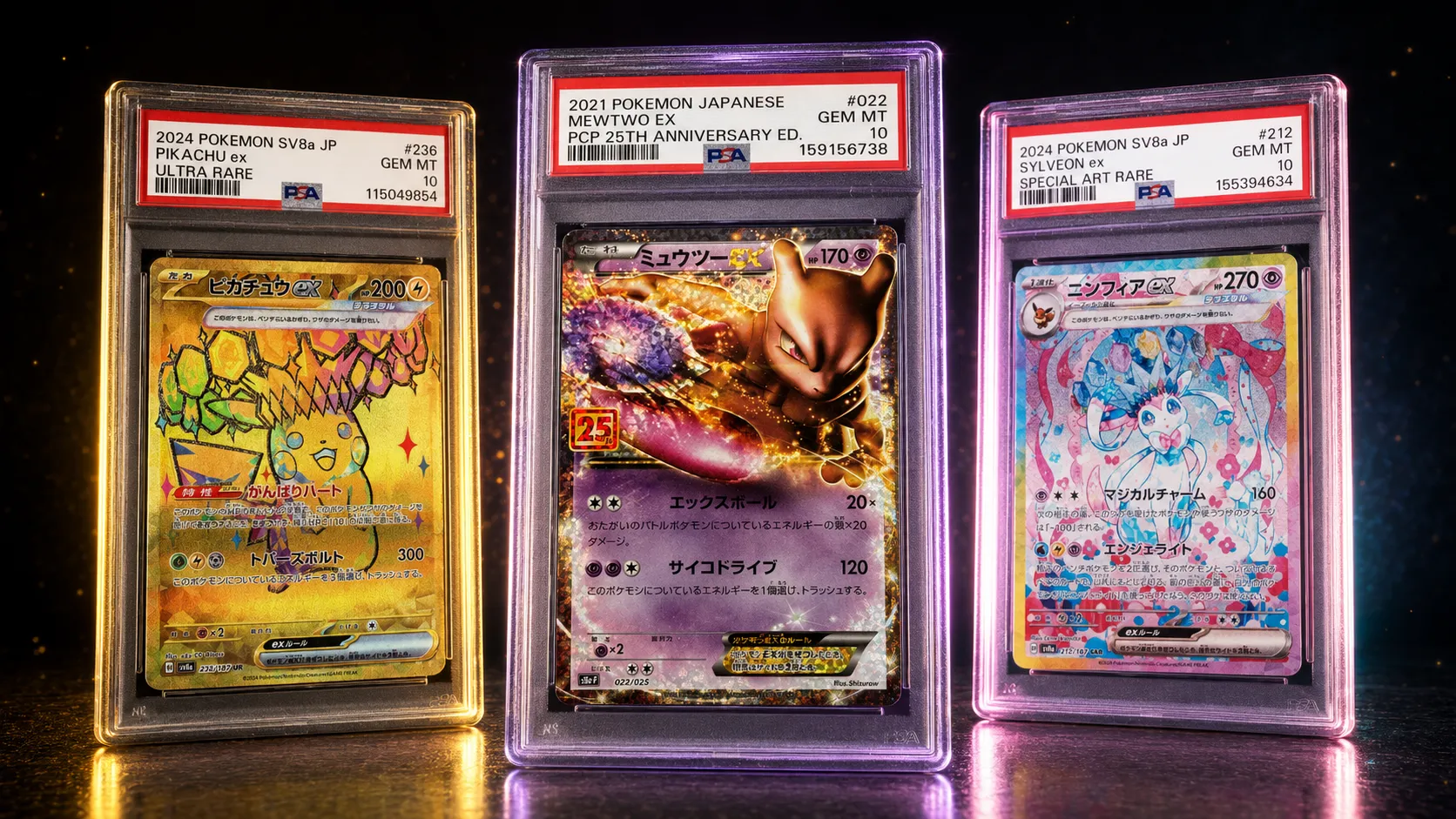
If you collect Japanese Pokémon cards, this question comes up fast: can you even send them to PSA, and if so, how does that actually work when you don’t live in Japan or the US? The short answer is yes — PSA grades Japanese cards under the same 10-point scale it uses for English cards. The longer, more useful answer is everything most guides skip: exactly what to buy before you pack a card, how PSA actually wants it packed (hint: probably not the way you think), what “declared value” really controls, and — critically for readers outside the US — which countries currently have a real submission route and which don’t, following a 2025 tariff-driven policy change most articles haven’t caught up to. Every claim below links its exact PSA source.
A note on sourcing: everything below about PSA’s process, standards, fees, and infrastructure is drawn directly from PSA’s own published pages (psacard.com and support.psacard.com), not from third-party grading blogs. We link the exact source for each claim. JariseStore’s core catalog is raw (ungraded), individually photographed Japanese singles, though we’ve occasionally carried PSA-graded cards too — we don’t have a standing commercial reason to push you toward or away from grading either way. This guide is here to answer the “can I, and how” question as completely and honestly as we can.
Can PSA grade Japanese Pokémon cards?
Yes. PSA’s grading standards are not language-specific — a Japanese-language card is graded on the exact same 10-point scale, using the exact same criteria, as an English one. A PSA 10 (Gem Mint) card must have four sharp corners, full original gloss, no staining, and centering within roughly 55/45 on the front and 75/25 on the reverse; a PSA 9 (Mint) allows exactly one minor flaw, such as a slight printing imperfection or marginally looser centering [1]. Nothing in that standard changes because the text on the card is Japanese instead of English.
PSA also isn’t a US-only operation as far as Japanese cards are concerned: the company opened a dedicated office in Tokyo specifically to serve the Japanese market, describing Pokémon (alongside Japanese baseball) as one of the categories most commonly submitted there [2]. So “it’s a Japanese card” is never, by itself, a reason PSA can’t grade it. The real complexity — which most guides gloss over — is logistics: what you physically need, how you pack it, and where in the world you’re allowed to send it. That’s the rest of this guide.
What you actually need before you submit
This is the part most articles skip entirely, and it’s where a lot of first-time submitters waste money or get their package rejected. Here’s the real shopping list, based on PSA’s own packaging requirements [6]:
| Item | Why you need it | Typical cost (checked Jul 2026) |
|---|---|---|
| Clear penny sleeves | Goes directly on the bare card. PSA explicitly says to avoid solid or opaque sleeves — they can delay your submission [6] | A few dollars for 100, from any card-supply retailer |
| Semi-rigid card holders (e.g. BCW #1, sized ~3⁵⁄₁₆” × 4⅞”) | PSA requires a semi-rigid holder over the sleeved card — not a toploader (see the callout below) | Around US$20–30 for a 50-count pack at general retailers (Walmart, Amazon) |
| Two cardboard dividers | Placed above and below your stacked cards before securing them for shipping [6] | Free — cut from any spare cardboard |
| 2–3 rubber bands | Secures the stack — snug enough that cards can’t shift, loose enough that they don’t dig into the holders [6] | Negligible |
| A new shipping box + packing material | PSA specifies a new box, with empty space filled so the stack can’t move in transit [6] | A few dollars |
| Packing tape (not painter’s, scotch, or reused tape) | Seals every seam of the box [6] | A few dollars |
| A jeweler’s loupe or 10x magnifier | Not required by PSA, but the single most useful thing for self-assessing centering, print lines, and surface scratches before you commit to grading fees (see the self-check table further down) | Roughly US$10–20 |
The mistake almost everyone makes: toploaders. If you’ve bought or sold raw singles before, your instinct is to reach for a rigid toploader — that’s the standard way to protect a card day-to-day, including how JariseStore ships its own raw singles. But PSA’s own packaging instructions are explicit: sleeve the card, then use a semi-rigid holder — do not use toploaders, tape, pull tabs, or sticky notes on the card itself [6]. Submitting cards in toploaders instead of semi-rigid holders is one of the most common first-time-submitter mistakes, and PSA’s guidance calls it out by name.
How to pack your cards for PSA, step by step
Once you have the supplies above, PSA’s own guide breaks packing down into five steps [6]:
- Don’t clean the card first. Leave it exactly as it is — see the callout below.
- Sleeve each card in a clear penny sleeve.
- Slide the sleeved card into a semi-rigid holder, making sure both sides are fully visible through the holder.
- Stack your cards in the exact order listed on your submission form — Item #1 on top — between two cardboard dividers, secured with 2–3 rubber bands: tight enough that the stack can’t shift, loose enough that it won’t dig into the holders.
- Print your submission form. PSA generates a few copies — the ones marked for shipping travel with the cards (a common trick from submitters: fold them and tuck them under the rubber bands securing your stack, so they can’t shift or get separated in the box), and you keep the remaining copy for your own records.
- Wrap the secured stack in packing material (bubble wrap over packing paper works well) and place it in a new shipping box, filling any empty space so nothing can move in transit.
- Seal every seam with packing tape (not painter’s, scotch, or reused tape) and attach the tracking label from your confirmation page to the outside, with any barcode fully visible. Ship with tracking and signature required — PSA’s insurance coverage only begins once the package is confirmed received at their facility, so the trip there is on you [7].
One detail worth repeating because it trips people up: the physical order of your stacked cards has to match the order on your submission form, Item #1 first. If they’re out of sequence, PSA can’t reliably match cards to line items — pack in the same order you entered them online.
Do not clean or wipe the card, ever. PSA has a specific designation — N7 — for evidence of cleaning: whitened borders, solutions used to remove stains, or any foreign substance (including cleaning spray or wax) applied to the surface. A card flagged N7 doesn’t get a numeric grade at all; at best it’s encapsulated as “Authentic Altered,” which is a worse outcome than submitting it dirty [1]. If you’ve heard advice to wipe a card down with a cloth before submitting — don’t. Handle it minimally and leave it exactly as you found it.
The submission form: service level and declared value
Before any of this, you’ll create a PSA account (a web account and, if you prefer, a mobile app login). PSA offers a free tier and a paid Collectors Club membership with discounts and submission perks — the paid tier mainly pays off if you submit multiple cards regularly, so a first-time submitter grading one or two cards has no real reason to pay upfront. You can always upgrade later.
Starting a submission means identifying your card in PSA’s system — set/year, brand or publisher, name, and card number — and picking the correct entry from the matching results, then choosing a service level and a declared value (also called Max Insured Value) for each card. These two numbers are linked, and getting them wrong is the second most common first-timer mistake after the toploader issue above.
Declared value / Max Insured Value is your estimate of what the card will be worth after grading. It sets two things: how much PSA will cover you for if the card is lost or damaged in their possession, and which service levels you’re even allowed to choose — for example, declaring a card at US$1,200 in graded form means you can only submit it at Express service or higher, not a cheaper entry tier [7]. Under-declaring to sneak into a cheaper tier isn’t a safe shortcut: if the card grades high enough that its realized value exceeds your declared amount, PSA can follow up asking you to pay an upcharge to bring the insurance coverage in line — so a surprise upcharge email is actually a decent sign your card scored well.
To actually estimate a graded value before you’ve graded the card, PSA points submitters toward its own Auction Prices Realized tool plus third-party sold-price trackers and marketplaces (Card Ladder, eBay, Goldin) — look up recent sales of the same card in the grade you realistically expect, not the grade you’re hoping for [7]. A simple, honest method that works in practice: pull up a handful of recent sold listings, see the range they cluster in, and declare somewhere in the middle of it rather than at the top — one collector we reviewed did exactly this, finding recent sales of their card between roughly US$500 and US$700 and declaring US$600. This is also exactly where the self-check further down this guide earns its keep: a more honest read on the likely grade gives you a more honest declared value.
Submitting from outside Japan and the US
This is the part most guides get out of date fastest, because the situation genuinely changed in 2025 and PSA has been actively rebuilding regional infrastructure through mid-2026. If you’re in Australia, New Zealand, Singapore, or the UAE, this section is the one that actually matters.
The tariff pause (since April 2025): following U.S. tariffs announced in April 2025, PSA temporarily paused accepting submissions directly to its U.S. facilities from customers located in every country outside the United States — the tariffs applied against the declared value of the items in a shipment, not PSA’s service fee, which made direct-to-US submission from abroad unexpectedly expensive [8]. That pause is still the operative starting point in 2026: if you’re outside the US, you generally can’t just box up a card and mail it straight to a PSA facility in America the way a US collector can, even though nothing has changed about PSA’s ability to grade the card itself.
In response, PSA has been standing up regional submission routes rather than reopening direct-to-US access for everyone:
- Japan: PSA’s Tokyo office handles domestic Japan submissions directly [2].
- United States: submit directly online through PSA’s own submission portal — the pause above doesn’t affect domestic US submitters.
- Canada: PSA operates a dedicated submission center in Halifax, Nova Scotia, plus a receiving location in Mississauga, in addition to PSA Authorized Dealers across the country.
- Singapore and much of the rest of Asia-Pacific: as of mid-2026, PSA routes these submissions through a new PSA Hong Kong Submission Center, opened specifically to keep APAC orders moving without US customs friction [9]. PSA names Singapore explicitly among the countries and territories served this way, alongside Indonesia, Malaysia, the Philippines, South Korea, Taiwan, Thailand, and Vietnam [10]. The process: create your submission through PSA’s Online Submission Center choosing “ship items back to me,” then mail your cards with a printed copy of the submission form to PSA Hong Kong (in-person delivery by appointment is also offered) [10]. If you’re in Singapore, this Hong Kong route is currently the real answer — not a US Authorized Dealer.
- Europe: PSA’s Frankfurt facility began accepting dealer and partner submissions in July 2026, with on-site grading expected to start in August 2026 [9] — evidence PSA is actively building out this infrastructure region by region, even if it isn’t relevant to our AU/NZ/UAE readers directly yet.
- Australia, New Zealand, and the UAE: here’s the honest gap. As of our research date, none of these are named in PSA’s Hong Kong/APAC routing announcement, none have a dedicated regional center the way Canada, Japan, and (now) Europe do, and the direct-to-US pause described above still applies to them. The realistic path right now is a PSA Authorized Dealer that runs group submissions on your behalf — for example, PSA lists an authorized dealer in Victoria, Australia that accepts group submissions. Search PSA’s own dealer directory for one in your country, and confirm current turnaround and handling directly with them, since this is the part of PSA’s network that changes fastest.
Customs, if you do get a card shipped back to you internationally: PSA files the customs paperwork electronically on your behalf and, by default, declares the shipment’s customs value as the total grading fee you paid (up to US$2,500) rather than the card’s collector value, with a description along the lines of “cards being returned to the owner after assessment — not sold items” [11]. If your order’s grading fees exceed that threshold, PSA splits it into multiple packages rather than filing extra export paperwork; if you want a different declared customs value for some reason, you attach a separate PSA customs form for it [11]. Either way, you — not PSA — are responsible for any customs duties, taxes, or carrier processing fees your country charges on the way back in. On plain return shipping cost: PSA’s postage page adds a flat surcharge for international return shipments on top of the domestic rate, and separately offers a prepaid FedEx 2-Day option at a meaningful discount to the standalone retail rate if speed matters to you [12].
The practical takeaway: “can PSA grade a Japanese card” and “can I currently get a card to PSA from where I live” are two completely different questions, and the second one has a real, country-specific, currently-changing answer. Check PSA’s dealer directory and the APAC routing page linked above before assuming either a direct mail-in or a dealer is your only option — and if you’re in the UAE specifically, this is worth confirming directly with PSA, since it’s the one region in this guide’s target audience with no named route at all yet.
That’s the outbound trip, to PSA. If you’re in Australia and wondering about the inbound side — ordering a raw card from Japan in the first place, and whether customs or GST adds anything on top — see our separate guide to shipping Pokémon cards from Japan to Australia.
What happens after you ship: tracking your submission
Once PSA has your card, a submission moves through a visible sequence of stages you can follow online or in the app: order arrived → order prep → research & ID → grading → assembly → QA checks → grades ready → completed. Realistic timelines vary a lot by service tier and current backlog (see the FAQ below), but as one concrete data point: one collector we reviewed shipped a modern card that PSA’s system estimated at 35 days, and it actually came back faster — arriving at PSA in mid-March 2026 with the grade ready in early April.
A few practical things worth knowing before you’re waiting on a submission:
- The app can build suspense on purpose. PSA’s app lets you reveal a completed grade by “flipping” the card image on screen rather than just showing you the number outright — a small detail, but if you’d rather not spoil it, don’t check your order receipt email first, since the numeric grade typically appears there plainly.
- An upcharge request is a good sign, not a bad one. As covered above, it usually means the card graded high enough that PSA wants your declared value (and the fee that goes with it) brought up to match — not that something went wrong.
- When your card arrives back, verify the certification number on PSA’s own site. It’s a quick way to confirm the record matches what you submitted, and it’s the same check worth running on any already-graded card you’re offered secondhand.
What PSA actually looks at (and how to check it yourself)
PSA’s published standard breaks a card down into the same handful of factors regardless of language: centering, corners, edges, and surface [1]. Here’s the self-check most collectors run before deciding whether a card is worth the cost of submission:
| What to check | What separates a likely 10 from a 9 | How to check it yourself |
|---|---|---|
| Centering | Front within ~55/45, back within ~75/25 [1] | Hold the card at arm’s length under bright, even light and compare the border width on opposite sides by eye, front and back — a loupe helps but isn’t required for this one |
| Corners | Four sharp points, no whitening or softness | Hold the card at a low angle to a light source (a “raking light” angle, roughly level with the card surface rather than pointed straight at it) and look at each corner edge-on — whitening catches the light even when it’s invisible head-on |
| Edges | Clean, no chipping or fraying | Same raking-light angle, run your eye slowly along each edge; a loupe makes small chips obvious |
| Surface | Full original gloss, no scratches, print lines, or indentations | Tilt the card slowly under a single light source at multiple angles — scratches and print lines on foil/holo surfaces are often invisible straight-on and only appear as the light rakes across them |
One thing worth flagging for modern Japanese sets specifically: many recent Japanese special-art cards (SAR, AR, SIR-style secret rares) are printed with tight factory centering, so centering is often not the thing that knocks a copy down from a 10. The more common failure point on glossy, foil-heavy modern cards tends to be surface — a scratch or print line that’s invisible in normal light but obvious the moment you tilt the card. If you’re self-assessing a card before submission, spend more time tilting it under a light at different angles than measuring borders with a ruler, and do this before you commit to a declared value and service level, not after.
A real example of why this matters: our own price tracking on the Japanese Mega Lucario ex SAR (088/063) and on Mewtwo AR 183/165 both show a large, real gap between raw and PSA 10 sold prices for the same card — on Mewtwo AR, roughly US$99 between a raw copy and a PSA 10 as of late July 2026. That gap is exactly why corner and surface condition on a raw copy is worth checking closely, with the technique above, before you decide whether submitting makes sense.
Our own grading — and how it helps before you submit
JariseStore’s day-to-day catalog is raw (ungraded) Japanese singles — every card we list is individually photographed and classified into one of four condition grades: NM (Near Mint), LP (Lightly Played), MP (Moderately Played), HP (Heavily Played). We have occasionally carried already-graded cards too (most recently a PSA 10 Gyarados and Magikarp pair from the Classic reprint set, CLK, sold in June 2026), but that’s the exception rather than the norm, and we have none in stock as we write this. Where raw singles matter for this guide: there are no stock photos in our listings — the photo you see is the exact card you’d receive, corners, surface, and centering included. The self-check table above is exactly what you’d be doing to one of our listing photos before deciding whether a copy looks like a plausible PSA candidate. An honestly photographed NM copy lets you make that judgment yourself, before you’ve spent money on supplies, a declared value estimate, and a grading fee.
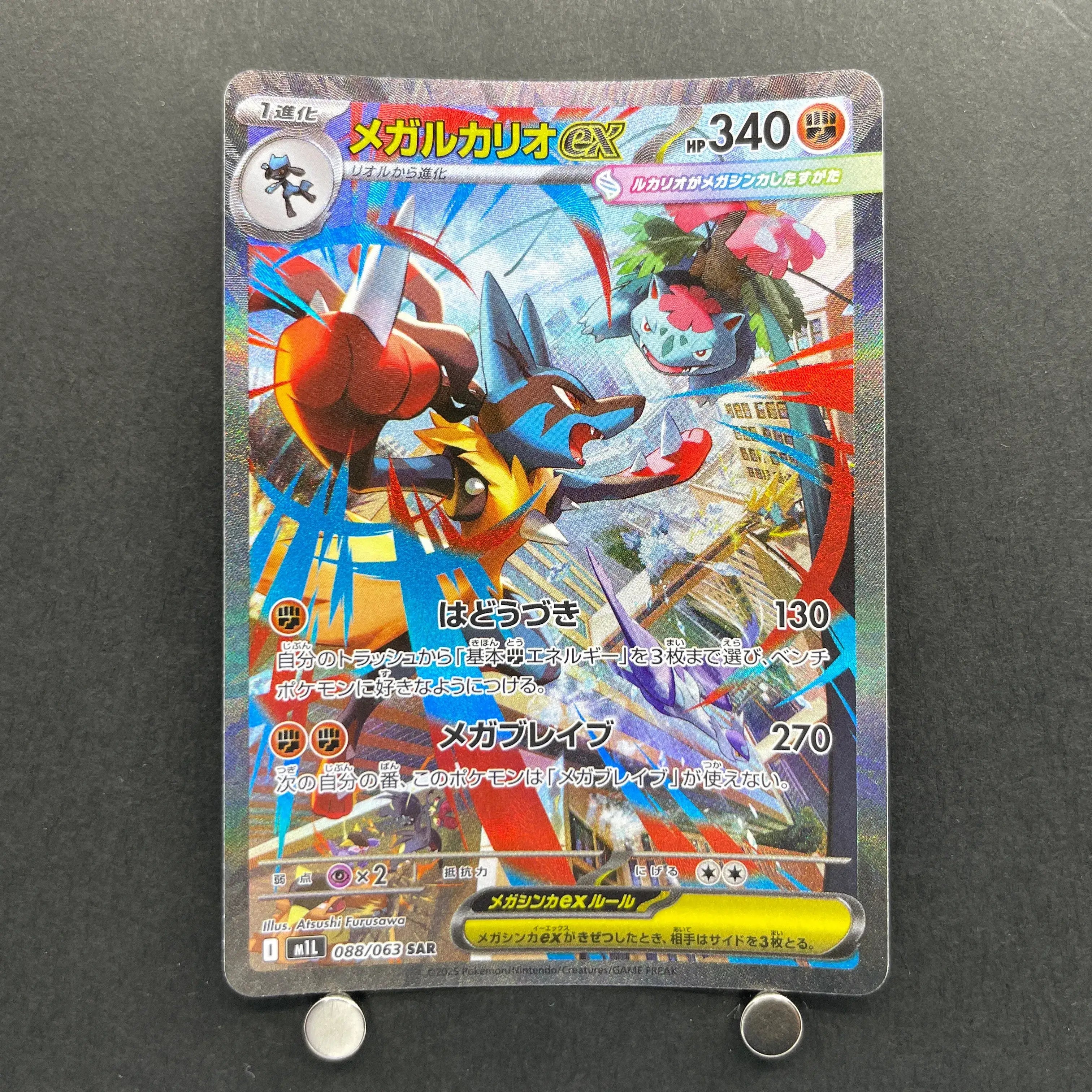
Mega Lucario ex SAR 088/063 (Mega Brave, M1L)
Price as of July 22, 2026
View at JariseStoreIs grading worth it? A quick self-check
We’re not going to tell you yes or no — it depends on the card and on what you want out of it. Add up the real cost before you decide: PSA’s own grading fee (check the current tier pricing directly — see the FAQ below for why we don’t print a number here), plus roughly US$20–40 in one-off supplies if this is your first submission (semi-rigid holders and sleeves are reusable across many future submissions, so this is mostly a first-time cost), plus return shipping — which carries an international surcharge on top of the domestic rate if you’re shipping outside the US [12]. A few honest questions worth asking against that total:
- Does the card’s raw value comfortably clear that total cost? Grading a low-value common against a $30–80 base fee plus shipping rarely pencils out.
- Does it pass the self-check above, under raking light? If you already see corner whitening or surface scratches at an angle, a 9 or lower is the realistic outcome, not a 10 — and that changes both the value math and your declared value.
- Do you actually want a slab, or do you want liquidity? A PSA 10 typically commands a real premium over a raw copy of the same card — our own tracking on cards like Mewtwo AR 183/165 and Mega Lucario ex SAR shows that gap directly, and it moves in both directions — it widened on Gengar & Mimikyu GX and shrank on Charizard ex SAR this summer — but a slab is also a specific, less flexible thing to own than a raw card, and grading takes real time (weeks to months depending on the tier you choose and PSA’s current backlog).
- Are you set up to actually submit from where you live? As covered above, that’s a genuinely different answer depending on your country in 2026, not a formality.
Looking for a raw copy worth considering for grading?
Every card at JariseStore is individually photographed and honestly graded before you buy — so you can run your own centering and surface check before deciding whether it’s a submission candidate.
Delivery: estimated transit approximately 1–3 weeks after dispatch; please allow up to 4 weeks.
FAQ
Can PSA grade Japanese Pokémon cards?
Yes. PSA uses the same 10-point grading scale and the same criteria (centering, corners, edges, surface) regardless of the card’s language [1]. PSA also operates a dedicated Tokyo office that handles Japanese-market submissions [2].
Can I use a toploader to submit my cards?
No — this is the single most common packaging mistake. PSA’s own instructions call for a clear penny sleeve plus a semi-rigid holder, and explicitly say not to use toploaders, tape, pull tabs, or sticky notes on the card [6]. Save the toploaders for everyday storage and display.
Should I clean my card before submitting it?
No — leave it exactly as it is. PSA has a specific designation (N7) for evidence of cleaning, including whitened borders or any foreign substance applied to the surface, and a card flagged this way doesn’t receive a numeric grade [1]. Whatever condition the card is in when you decide to submit it is the condition PSA should see.
What do I need to buy before I submit?
At minimum: clear penny sleeves, semi-rigid card holders sized for standard trading cards, cardboard dividers, rubber bands, a new shipping box with packing material, and non-reused packing tape [6]. Budget roughly US$20–40 for your first submission if you don’t already own any of it — most of it (holders, sleeves) covers many future submissions, not just one.
What is “declared value” or “Max Insured Value,” and why does it matter?
It’s your estimate of the card’s value after grading. It sets your insurance coverage if PSA loses or damages the card, and it restricts which service tiers you can choose — a higher declared value requires a higher (more expensive) service level [7]. PSA suggests checking its own Auction Prices Realized tool alongside sold listings on Card Ladder, eBay, or Goldin to estimate it realistically [7].
How much does PSA grading cost?
It depends on the service tier you choose, and PSA has changed its tiers and pricing more than once in 2026 in response to submission volume [3]. Rather than quote a figure that may already be out of date, check PSA’s current pricing page directly before you submit [4].
How long does PSA grading take?
It varies by service level and current backlog — anywhere from a few weeks to several months. PSA publishes estimated turnaround times per tier on its own site, and these estimates have shifted during 2026, so check the current figures rather than relying on a number from an older article.
Can I submit Japanese cards to PSA from Australia, New Zealand, Singapore, or the UAE?
It depends which of these you mean, and the answer changed in 2025–2026. Since April 2025, PSA has paused direct-to-US submissions from every country outside the US, due to US tariffs on declared item value [8]. Singapore now has a real regional route: PSA’s Hong Kong Submission Center, opened in 2026, explicitly serves Singapore among other APAC countries [10]. Australia, New Zealand, and the UAE aren’t named in that routing yet — the realistic path for now is a PSA Authorized Dealer running a group submission on your behalf; check PSA’s dealer directory for one near you, and confirm directly with PSA if you’re in the UAE, since it’s the least-covered region here.
Does a Japanese-print card grade differently than an English one?
Not by PSA’s published standard — the centering, corner, edge, and surface criteria are the same for both [1]. In practice, many modern Japanese special-art cards have tight factory centering, so surface condition (scratches and print lines on glossy foil) tends to be the more common reason a copy misses a 10, rather than centering.
Methodology & data sources
All claims about PSA’s grading standards, packaging requirements, submission form, fees, and international infrastructure are drawn directly from PSA’s own published pages (psacard.com, support.psacard.com, and resources.psacard.com), checked July 22, 2026: grading standards [1], Tokyo office announcement [2], February 2026 pricing/service update [3], current cost overview [4], packaging instructions [6], Max Insured Value definition [7], 2025 tariff regulations update [8], Hong Kong Submission Center announcement [9], APAC submission routing [10], international shipping/customs guidelines [11], and postage rates [12]. Several of these pages returned an access error to our automated fetch tool, so their content was confirmed via search-engine-indexed snippets of the same official URLs rather than a direct render — we’re flagging that limitation rather than hiding it. We deliberately did not reproduce PSA’s specific current dollar pricing or turnaround-time tables for grading fees, since PSA has revised both more than once in 2026 and a printed figure would risk becoming stale; readers should check PSA’s own pages linked above for current numbers. Supply pricing (semi-rigid holders, sleeves) reflects general retail listings (Walmart, Amazon) checked July 22, 2026, not any single vendor’s official price, and is meant as a rough budget, not a specific recommendation. The featured Mega Lucario ex SAR listing (¥9,500, Near Mint, JariseStore inventory) was confirmed in our store system on July 22, 2026; the JPY currency conversion shown uses the ECB reference rate as of July 15, 2026, the most recent rate available to us at time of writing. We checked our own sales and inventory records on July 22, 2026: JariseStore has occasionally sold PSA-graded cards (a PSA 10 Gyarados and Magikarp pair from the Classic/CLK reprint set, sold June 18, 2026, per our order records), but we have none in stock as of today — which is why this guide’s calls to action point to raw inventory rather than graded cards. Our catalog is predominantly raw singles; graded cards are the exception. The concrete submission timeline, declared-value example, and app/tracking details are drawn from a single firsthand account shared publicly by a collector who submitted a modern card to PSA in 2026 — we’ve flagged those points in the text as one person’s real experience, not official PSA policy, since a sample of one doesn’t establish a typical timeline or cost. Competitor resale/content-marketing sites were not used as sources for this article.
About JariseStore
JariseStore is a Japan-based specialist in Japanese Pokémon single cards, shipping to collectors worldwide. Every card we sell is sourced in Japan, individually photographed, and honestly graded — no surprises, what you see is what you get. Questions about a card or shipping? Reach out on Instagram @jarisestore.
Information shown reflects PSA’s publicly available policies and pricing as of July 22, 2026 and can change — this is an area PSA has actively been revising throughout 2025–2026; always confirm current pricing, packaging requirements, turnaround times, and submission options directly with PSA before submitting a card. This article is for informational purposes only and is not investment or grading advice. Pokémon and all card names are trademarks of their respective owners; PSA is a trademark of Collectors Universe / Professional Sports Authenticator. JariseStore is an independent reseller and is not affiliated with The Pokémon Company or PSA.


.png)