Japanese Art Rare (AR) Cards: The Tier That Actually Sells
Over 28 days, Art Rare and Special Art Rare listings in our store were viewed almost exactly the same number of times — 619 views versus 637. What happened next was not the same at all. Art Rares were added to cart 151 times; Special Art Rares, 16 times. 23 different Art Rare cards sold, from 12 different Japanese sets. Exactly one Special Art Rare sold. Same shelf, same traffic, one tier moving. This guide explains what AR actually is, why the gap looks the way it does, and how to use that if you are the one deciding what to buy.
JariseStore store analytics, August 16 – September 12, 2026 (28 days). Raw single cards only — graded slabs are excluded throughout. Prices are our own listed prices in USD, medians not averages. Method and limits are set out at the end.
What AR actually means
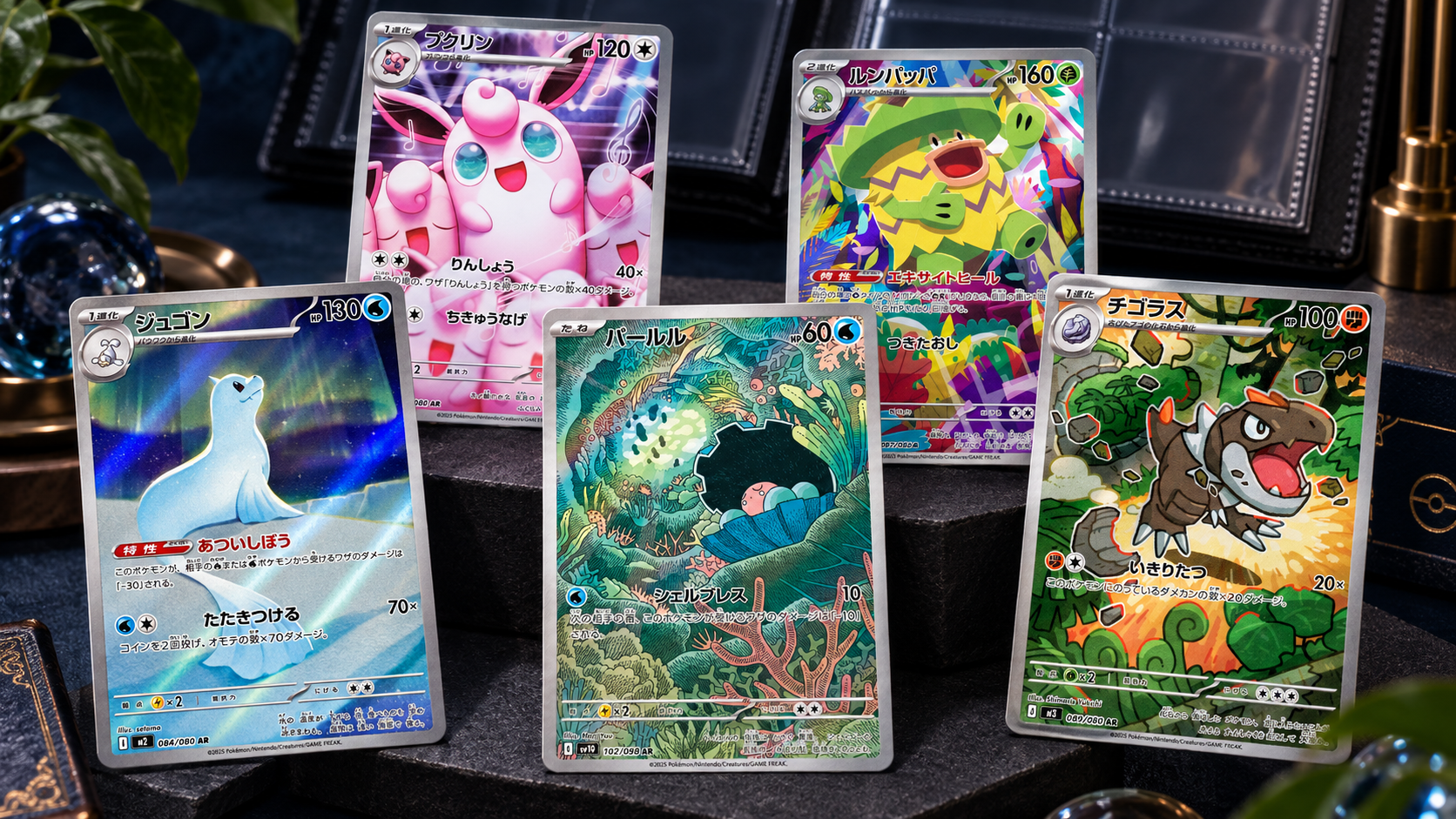
AR stands for Art Rare: a full-art alternate illustration of an otherwise ordinary card, numbered above the main set size. If a set runs to 083 cards, the Art Rares start at 084/083 and climb from there. The Pokémon in the artwork is usually a common or uncommon — a Vulpix, a Froakie, a Wigglytuff — drawn in a scene rather than posed against a template.
Art Rares were introduced in the Japanese set VSTAR Universe (s12a), released December 2, 2022, at the same time as Special Art Rare [1] [2]. Our own price database agrees: the oldest Japanese set in which we hold any AR-rarity card is s12a, and it contains 37 of them — matching the figure reported at the set’s announcement.
The two tiers are easy to confuse because the artwork style is similar. The difference is not how special the art is. It is how thin the print run is, and which cards get chosen.
| Art Rare (AR) | Special Art Rare (SAR) | |
|---|---|---|
| Typical count in a regular expansion set | About 12 | A handful |
| Which cards get the treatment | Ordinary Pokémon | Headline ex / V-class cards |
| Median listed price in our store | US$11.09 | US$433.69 |
| Middle half of our listings | US$6.18 – US$21.45 | US$53.17 – US$660.46 |
| Closest English equivalent | Illustration Rare | Special Illustration Rare |
Prices as listed in our store between August 16 and September 12, 2026, raw single cards only. Set counts and the English mapping were checked separately on September 14, 2026. Set counts are from our own price database, which captures a complete rarity block for ten Japanese expansion sets — all ten contain exactly 12 Art Rares. High-class packs and anniversary sets are a different animal and can run from 17 up to 72. The English mapping is broadly right but, as Bulbapedia puts it, does not provide a full overlap [1] — do not assume a Japanese AR always has an English twin. If the Japanese-versus-English question is the one you actually came with, we compared both printings of the same cards in Japanese vs English Mega ex prices.
What our store data shows
We track every product-page view, add-to-cart and purchase in our store. Grouping 28 days of that by the rarity code printed on the card gives the following. This is the part of the guide that no price aggregator can reproduce, because it is behaviour rather than price.
| Rarity | Distinct listings | Product views | Added to cart | Add-to-cart rate | Different cards sold | Median listed price |
|---|---|---|---|---|---|---|
| AR (Art Rare) | 194 | 619 | 151 | 24.4% | 23 | US$11.09 |
| MA (Master Art) | 6 | 47 | 8 | 17.0% | 1 | US$41.79 |
| CHR (Character Rare) | 5 | 36 | 4 | 11.1% | 2 | US$108.95 |
| SR (Super Rare) | 37 | 182 | 11 | 6.0% | 2 | US$197.49 |
| RR (Double Rare) | 19 | 75 | 3 | 4.0% | 0 | US$256.99 |
| SAR (Special Art Rare) | 47 | 637 | 16 | 2.5% | 1 | US$433.69 |
JariseStore store analytics, August 16 – September 12, 2026 (28 days), raw single cards only — graded slabs excluded. Rows are ordered by median price, cheapest first. “Distinct listings” is the number of individual listings in that tier that were viewed at least once, not our total stock. “Add-to-cart rate” is add-to-cart events divided by product-view events for that rarity — it is an event ratio, not a per-visitor conversion rate. “Different cards sold” counts distinct cards by name and collector number, not copies. Tiers with fewer than 30 product views in the window are omitted.
Read the AR and SAR rows together, because the comparison only works because the traffic is level. Special Art Rares were actually looked at slightly more than Art Rares. It is not that nobody wants the expensive cards — people look at them constantly. The tiers separate at the moment of deciding, not the moment of browsing.
The second pattern is the one we did not expect. Sort the six tiers by price and the add-to-cart rate falls in exactly the same order, without a single exception: US$11 → 24.4%, US$42 → 17.0%, US$109 → 11.1%, US$197 → 6.0%, US$257 → 4.0%, US$434 → 2.5%. Six tiers, six steps down, no inversions. Whatever else rarity is doing in this shop, price is doing more of it.
If you want to see the tier rather than read about it: our Japanese Art Rare listings are here. Everything is a single card, individually photographed and condition-graded before listing. There is no need to decide anything from this page — most of what follows is about how to choose well once you are looking.
Why the gap is this wide
The reason is price, and specifically which side of a decision threshold the price falls on.
The middle half of our Art Rare listings sits between US$6.18 and US$21.45. The middle half of our Special Art Rares sits between US$53.17 and US$660.46. Those are not two points on one scale; they are two different kinds of purchase. One is the price of a paperback. The other, at the top end, is the price of a flight.
At the Art Rare level, a collector who likes the artwork can simply buy the card. At the Special Art Rare level the same collector has to decide whether this is the card, this month, at this price — and a large share of those decisions end in a closed tab. That is what a 24.4% versus 2.5% add-to-cart rate looks like from the inside.
There is a detail in the sales data that makes the point more sharply than the rates do. The one Special Art Rare that did sell in these 28 days was listed at US$19.21 — a Bloodmoon Ursaluna ex SAR 225/187 from Terastal Fest ex (sv8a), priced inside the Art Rare band rather than the Special Art Rare one. The single SAR that cleared was the single SAR that was not priced like an SAR.
There is also a second, quieter reason: availability. Across our daily price tracking, the median number of active listings across the market was 44 for Art Rares against 29 for Special Art Rares (checked September 14, 2026). A tier you can reliably find in the condition you want is a tier you can actually collect. A tier where the one copy you want is never in stock is a tier you admire.
All 23 that sold
Here is every Art Rare that sold in those 28 days — not a selection, the complete list. They span 12 different Japanese sets.
That spread is the finding, not the individual names. If one card had been a third of the sales, this would be a story about that card. Instead the demand is thin and wide: a Kecleon here, a Clefairy there, almost nobody buying the same thing twice. People are not chasing a specific Art Rare. They are buying from the tier.
| Card | Set | Our listed price |
|---|---|---|
| Cynthia’s Spiritomb AR 208/193 | Mega Dream ex (M2a) | US$3.52 |
| Team Rocket’s Dugtrio AR 206/193 | Mega Dream ex (M2a) | US$3.02 – 4.71 |
| Clamperl AR 102/098 | Glory of Team Rocket (sv10) | US$4.36 |
| Ludicolo AR 081/080 | Inferno X (M2) | US$4.50 |
| Wigglytuff AR 091/080 | Inferno X (M2) | US$4.92 – 5.85 |
| Dewgong AR 084/080 | Inferno X (M2) | US$5.22 |
| Steelix AR 073/063 | Mega Brave (M1L) | US$5.40 |
| Tyrunt AR 089/080 | Nihil Zero (M3) | US$6.26 |
| Altaria AR 087/076 | Storm Emeralda (M6) | US$6.33 |
| Gothorita AR 078/071 | Snow Hazard (sv2p) | US$6.44 |
| Team Rocket’s Raticate AR 108/098 | Glory of Team Rocket (sv10) | US$6.98 |
| Shuckle AR 064/063 | Mega Symphonia (M1S) | US$7.20 |
| Vulpix AR 067/063 | Mega Brave (M1L) | US$8.59 |
| Dusknoir AR 070/064 | Night Wanderer (sv6a) | US$10.47 |
| Arbok AR 079/071 | Wild Force (sv5k) | US$10.67 – 10.81 |
| Ceruledge AR 109/106 | Supercharged Breaker (sv8) | US$11.24 |
| Froakie AR 086/083 | Ninja Spinner (M4) | US$11.69 |
| N’s Zekrom AR 210/193 | Mega Dream ex (M2a) | US$13.50 |
| Clefairy AR 086/080 | Nihil Zero (M3) | US$14.32 – 14.39 |
| Team Rocket’s Houndoom AR 100/098 | Glory of Team Rocket (sv10) | US$14.39 |
| Kyogre AR 080/076 | Storm Emeralda (M6) | US$21.69 |
| Kecleon AR 088/076 | Storm Emeralda (M6) | US$21.32 – 21.70 |
| Groudon AR 084/076 | Storm Emeralda (M6) | US$23.95 |
Prices as listed at the time of sale, August 16 – September 12, 2026, in USD. These are the specific copies that sold in that window, so the exact card and condition shown here will often be gone — the links go to a store search for that card rather than to a dead product page. Where a range is shown, two separate copies sold at different prices, usually in different conditions. Sorted by price, cheapest first. Every card in this table is a raw single; graded slabs are excluded from this article’s data entirely.
If you would rather browse a full set than a list of what happened to sell, our set checklists cover every secret rare with numbers and prices: Ninja Spinner (M4), Abyss Eye (M5) and Black Bolt & White Flare.
The case against AR
It would be easy to stop here, and dishonest. Three things cut the other way, and you should have all of them before you spend anything.
1. Art Rares are not holding value better than Special Art Rares. We expected to find that they were. They are not. Over August 18 – September 12, 2026, the median price change across our tracked cards was −1.25% for Art Rares (471 cards) and −1.05% for Special Art Rares (182 cards) — close together, and if anything marginally worse for AR. Both tiers are drifting gently down. The honest version of this article’s argument is “this tier sells”, not “this tier holds”.
What we can say is narrower: the cheap tier is not collapsing faster than the expensive one. The share of cards that fell more than 10% over that window was 13.6% for Art Rares and 11.5% for Special Art Rares. And the upside tail is slightly fatter for AR — the top quartile of Art Rares rose 3.33% or better, against 0.78% for Special Art Rares, and 6.37% versus 3.51% over a longer window running back to July 6, 2026. Slightly fatter. Not a reason to buy cards as an investment, which we would not advise in either tier.
Price movement figures cover August 18 – September 12, 2026 (21 days on which our price database recorded prices), and the longer window runs July 6 – September 12, 2026. This is not the same window as the store behaviour data above, which runs from August 16 — our price database has no entries for August 16 or 17, so the two cannot be aligned exactly. We have kept them separate rather than rounding one to match the other.
2. Graded demand runs the other way. In our price tracking, the median number of PSA 10 sales recorded on eBay was 38 for Special Art Rares against 17 for Art Rares (checked September 14, 2026). The slab market wants the expensive tier. Everything else in this article describes raw single cards sold by a shop, with graded listings deliberately excluded from the counts; it does not describe the graded market, and the two genuinely behave differently. If your intention is to grade and resell, this guide is the wrong input — start with our PSA grading guide instead, and note that a grading fee against an US$11 card is more than the card.
3. One store is one store, and one of these numbers is a single sale. Everything above describes what happened in our shop over 28 days, to an audience that found us. A store with a different inventory mix, or one better known for high-end singles, would very likely see a different shape. And the sharpest-sounding comparison — 23 Art Rares sold against one Special Art Rare — rests on one SAR sale, which is as small as a sample gets. The add-to-cart layer is where this article’s evidence actually lives: 151 events from 49 distinct visitors against 16 from 14. We think the mechanism generalises, because price thresholds are not unique to us. We cannot show you that it does.
How to pick one
Three things worth knowing before you buy in this tier specifically.
Buy the artwork, not the Pokémon’s competitive relevance. Art Rares are applied to ordinary Pokémon, so nothing in this tier is a chase card in the tournament sense. That is freeing: there is no wrong answer, and a Gothorita you like is a better purchase than a Charizard you don’t. The tier’s own logic rewards taste.
Read the condition code, because it moves the price meaningfully at this level. Our listings are graded NM (Near Mint), LP (Lightly Played), MP and HP, and at an US$11 median the gap between NM and LP is a real fraction of the price rather than a rounding error. Two copies of Wigglytuff AR 091/080 sold in our window: the NM at US$5.85, the LP at US$4.92. Decide which you are buying before you compare prices across shops.
If you want to complete something, work by number rather than by name. Art Rares run in an unbroken block immediately above the main set size — so in a set of 083 cards they occupy 084/083 upward, and in a regular expansion there will usually be twelve of them. That makes the tier unusually well suited to set-building on a budget, which is not true of Special Art Rares. For a single card’s price history rather than a tier overview, we tracked one in detail in Hisuian Growlithe AR 075/066.
So — AR or SAR?
They answer different questions, and the budget decides which question you are asking.
At US$50, you are not close to a median Special Art Rare in our store. You are comfortably inside four Art Rares — and, on the evidence above, that is what people in that position actually do.
Special Art Rare is the tier where you pick one card, deliberately, because that specific card matters to you. It is a decision, and the price is supposed to make you think. Art Rare is the tier where you collect: you buy the art you like, you finish a number block, you add to it when something catches your eye. Neither is the beginner version of the other. If the artwork on a US$400 Special Art Rare is the thing you want, no quantity of Art Rares substitutes for it.
What the data does argue against is the default assumption — that the expensive tier is the real one and the cheap tier is what you settle for. In our store, over 28 days, the cheap tier is the one people bought.
Browse Japanese Art Rares
Single cards from Japan, individually photographed and condition-checked before listing. Most sit between US$6 and US$21.
Shipped from Japan with tracking. Transit is approximately 1–3 weeks after dispatch — see our shipping and customs guide if you are ordering from Australia.
FAQ
What does AR mean on a Japanese Pokémon card?
AR stands for Art Rare: a full-art alternate illustration of an otherwise ordinary card, numbered above the main set size. Art Rares were introduced in the Japanese set VSTAR Universe (s12a) on December 2, 2022, at the same time as Special Art Rare [1].
What is the difference between AR and SAR?
The artwork style is similar; the scarcity is not. A standard Japanese expansion set contains about twelve Art Rares but only a handful of Special Art Rares, and SAR is applied to headline ex cards rather than ordinary ones. That gap shows up in price: across our raw single-card listings viewed between August 16 and September 12, 2026, the median AR was US$11.09 and the median SAR was US$433.69. AR is not a downgraded SAR — it is a different level of scarcity applied to a different set of cards.
Are Japanese AR cards worth money?
Most sit in a low-double-digit range rather than a collectible-investment range — the middle half of our Art Rare listings priced between US$6.18 and US$21.45. They sell steadily at that level: 23 different Art Rares from 12 different Japanese sets sold in our 28-day window, against exactly one Special Art Rare.
Is a Japanese Art Rare the same as an English Illustration Rare?
They are the closest equivalents — Japanese AR corresponds broadly to English Illustration Rare, and SAR to Special Illustration Rare. Bulbapedia notes the mapping does not provide a full overlap [1], so do not assume every Japanese Art Rare has an English counterpart or the same print treatment. We compared both printings of the same cards in Japanese vs English Mega ex prices.
Is it worth grading an Art Rare card?
Usually the grading fee is a large fraction of the card’s value, so it rarely makes sense in the US$6–21 range. Graded demand also concentrates higher up the ladder: the median number of PSA 10 eBay sales in our tracking was 38 for Special Art Rares against 17 for Art Rares (checked September 14, 2026). Our PSA grading guide works through when it does make sense.
How many Art Rares are in a Japanese set?
Twelve is the standard count for a regular Japanese expansion — that held for all ten sets where our price database captures the complete rarity block. High-class packs and anniversary sets are different and can contain far more, from 17 up to 72. As one data point on pull rates: a collector opening a 20-pack box of the 30th Anniversary Celebration set reported 4 Art Rares and 1 Special Art Rare [3]. That is one box, self-reported, from a non-standard set — treat it as an anecdote, not a rate. The Pokémon Company does not publish pull rates.
Is AR rarer than SR?
They are not on the same ladder, so neither is simply rarer. SR (Super Rare) is a foil treatment applied within the main set numbering; AR sits above the main set size as an alternate full-art illustration. In practice they behave differently: across our raw listings viewed between August 16 and September 12, 2026, the median SR was US$197.49 against US$11.09 for AR, and SR listings were added to cart 6.0% of the time against 24.4% for AR.
Where can I buy Japanese Art Rare cards?
We sell Japanese singles from Japan, including the tier described here — our Art Rare listings are here. Wherever you buy, the things worth checking are the same: a photograph of the actual card rather than a stock image, a stated condition grade, and tracked shipping. Art Rare stock turns over quickly, precisely because the tier sells — so if the specific card you want is unavailable, it is usually worth checking again rather than paying a premium elsewhere. For import questions from Japan, see our shipping and customs guide.
Methodology & data sources
Store behaviour data. JariseStore site analytics (GA4), August 16 – September 12, 2026, a 28-day window, retrieved September 14, 2026. Rarity is read from the code printed in each product title (the “AR” in Kecleon AR 088/076). Product views, add-to-cart and purchase are counted as events at the individual-listing level; orders are counted by distinct transaction. Graded slabs are excluded from every figure in this article — 355 events on PSA-graded listings were removed before any of these numbers were calculated, because the argument here is about raw single cards and mixing the two would describe neither. “Different cards sold” counts distinct cards by name and collector number, so two conditions of the same card count once. No customer-identifying data is used or published anywhere in this article.
Two limits on the headline numbers, stated plainly. First, “add-to-cart rate” is an event ratio — add-to-cart events divided by product-view events — not a per-visitor conversion rate, and one person viewing a card three times counts three times. Second, the add-to-cart layer is where the sample is solid (151 events from 49 distinct visitors for AR, 16 from 14 for SAR); the completed-order layer is small (9 orders against 1). That is why this article leads with add-to-cart rates and counts of distinct cards sold, and does not quote a multiple on order counts. One SAR sale will not carry that weight, and we say so in the section above rather than burying it here.
Prices. Our own listed prices in USD, from the same window and the same raw-singles-only population. Medians and quartiles computed as exact percentiles, never averages — a handful of high-end listings distort the mean badly. Our Special Art Rare inventory skews toward high-end chase cards, so our SAR median is higher than the market-wide median for that rarity; the SAR figures here describe our shelf, not the whole market.
Market price movement, listing counts and PSA 10 sale counts. JariseStore daily price tracking, which follows TCGplayer market prices and eBay sold data across 471 Art Rare and 182 Special Art Rare cards. Retrieved September 14, 2026. The price-movement window is August 18 – September 12, 2026, not the August 16 – September 12 window used for the store behaviour data. Our price database has no entries for August 16 or 17, and 21 recording days inside that range, so the two datasets cannot be aligned exactly — we report each on its own window rather than stretching either. The longer comparison runs July 6 – September 12, 2026. Listing counts and PSA 10 sale counts are as at September 14, 2026.
Set composition and rarity history. Cross-checked between Bulbapedia [1], PokeBeach’s set announcement coverage [2] and our own price database. Where the two disagreed we said so rather than picking one. Pull-rate figures are not published by The Pokémon Company; the single box result cited in the FAQ [3] is one collector’s self-reported opening and is labelled as such.
About JariseStore
We are an independent shop in Japan selling Japanese Pokémon singles to collectors overseas. Every card is individually photographed and condition-checked before it is listed, which is also why we have card-level data to write articles like this one. You can see what we are listing day to day on Instagram at @jarisestore.
Prices and trends shown reflect data available as of September 14, 2026 and can change quickly in the trading card market. This article is for informational purposes only and is not investment advice. Pokémon and all card names are trademarks of their respective owners; JariseStore is an independent reseller and is not affiliated with The Pokémon Company.