Shipping Pokémon Cards to Australia: Customs, GST & Delivery (2026)
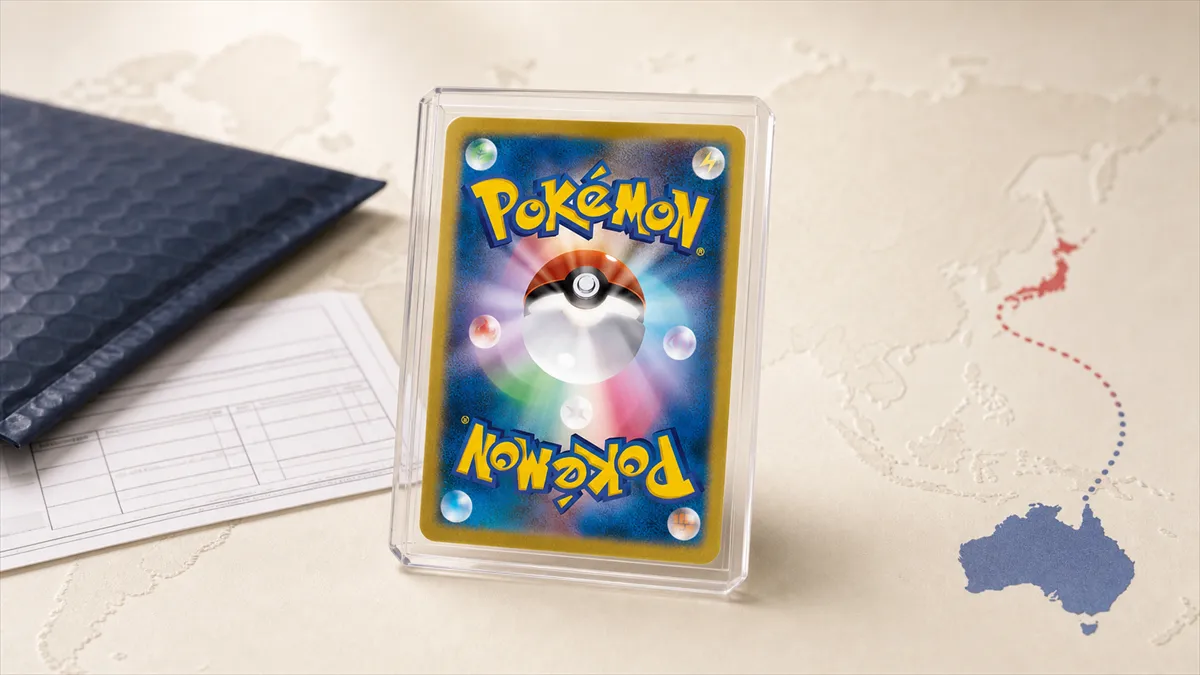
Most personal Pokémon card orders with a customs value of A$1,000 or less do not attract duty or GST at the Australian border. Australian GST may still be collected at checkout by a GST-registered merchant, marketplace, or re-deliverer. Orders above A$1,000 require an import declaration, and GST, processing charges and — depending on tariff classification and any available preference — customs duty may apply. This guide walks through where that line actually sits, how it’s measured (it is not your cart total), and what to realistically expect on delivery times.
Scope: this guide is written for an individual consumer in Australia buying cards for personal use, not for commercial importers — and it covers importing into Australia, not sending cards out for grading. If you’re still deciding whether to collect Japanese cards at all, start with Japanese vs English Pokémon cards. Rules and rates are from the Australian Border Force, the ATO, and DFAT, checked July 26, 2026 — sources are linked at each claim and listed at the end.
Will you be charged customs duty or GST?
There are two separate questions hiding inside this one, and conflating them is where most confusion starts.
At the border: for consignments with a customs value of A$1,000 or less, there are generally no duties, taxes or charges to pay on arrival — the exceptions being alcohol and tobacco, which are taxed regardless of value [1].
At checkout: that is a different matter. Since 1 July 2018, eligible low value imported goods may be subject to GST at the point of sale rather than at the border [2]. A merchant, marketplace (an electronic distribution platform), or re-deliverer (a parcel-forwarding service) that meets the Australian GST registration requirements must generally collect it — the registration test being current or projected GST turnover connected with Australia of A$75,000. Businesses below that threshold may also register voluntarily [3].
So the practical answer is: usually nothing extra arrives after the fact on a normal-sized order, but whether GST appears within the price you pay depends on the seller’s registration status. That varies from store to store, so it’s worth checking the total at checkout and the store’s own tax and shipping policy before ordering, whoever you’re buying from.
Where JariseStore sits, specifically: we are not registered for Australian GST and do not collect it at checkout. Combined with the general position above — no duty or GST at the border for consignments valued at A$1,000 or less — that means a typical order from us arrives without Australian tax added at either point. This describes our current registration status rather than a permanent guarantee, and it does not override the rules for consignments above A$1,000, which are covered in the next two sections. As with any overseas order, import duties and taxes that do apply remain the buyer’s responsibility and are not included in our product prices.
The A$1,000 threshold, explained
Two things decide what happens to your parcel: the customs value and how it travels.
| Customs value / method | Declaration | Duty & GST at the border |
|---|---|---|
| A$1,000 or less — international mail | No SAC or import declaration normally required [4] | Generally none. GST may instead be collected at checkout [1] |
| A$1,000 or less — air / sea cargo | Self-Assessed Clearance handled by the carrier | Generally none. GST may instead be collected at checkout [2] |
| Over A$1,000 — international mail | Form B374 (N10) [5] | Import GST, any applicable duty, plus processing and biosecurity charges |
| Over A$1,000 — air / sea cargo | Form B650 (N10), or an electronic N10 lodged by a broker [5] | Import GST, any applicable duty, processing and biosecurity charges |
The threshold is customs value, not your cart total. Customs value is based on the price of the goods themselves and generally excludes the international transport and insurance costs from the place of export [6]. So a checkout total that edges over A$1,000 because of shipping is not automatically over the line. Two related things worth knowing: foreign-currency amounts are converted to Australian dollars using the exchange rate set for the date of export, so a purchase sitting near the line can land on either side of it; and if several orders are consolidated into one consignment, it’s the combined customs value that counts.
How often does this actually bite? Across all 493 orders in our store records from February 2022 to July 2026 — all destinations, not Australia alone — the median order works out to roughly A$62, the 95th percentile to about A$386, and exactly one order (0.2%) would have converted to more than A$1,000. This indicates that the A$1,000 threshold has rarely been relevant in our historical store-wide order mix. It is not an Australia-specific rate or a customs-value calculation. Going over the threshold is uncommon for single-card and small-lot buying, but it is not impossible, and it’s worth checking if you’re building a large order of high-end singles. (Method and caveats are in the sources note at the end.)
If your order does go over A$1,000
Four cost categories may come into play, and they’re calculated differently from one another.
Customs duty. A 5% general rate may apply depending on how the goods are classified — collectible cards can fall under headings in Chapter 95 carrying a 5% general rate [7]. But goods that qualify as originating in Japan may receive a free rate under the Japan-Australia Economic Partnership Agreement (JAEPA), provided the rules of origin are met and the claim is supported by a valid Certificate of Origin or Origin Certification Document [8]. Two cautions there: shipping from Japan is not the same thing as originating in Japan, and classification can differ depending on the form of the item — a loose single, a sealed product, and a slabbed graded card are not automatically treated alike.
Import GST. This is 10% of the Value of the Taxable Importation (VoTI), not 10% of the card price. VoTI is the customs value plus any customs duty plus the international transport and insurance costs to Australia (plus Wine Equalisation Tax where applicable, although it is not relevant to trading cards) [9]. Note the asymmetry that catches people out: shipping is excluded when testing the A$1,000 threshold, but included when calculating GST above it.
Import processing charge. As at 1 July 2026, ABF’s published rates are A$50 for an electronic declaration and A$90 for a documentary one where the consignment value is between A$1,000 and A$10,000, rising to A$152 electronic and A$192 documentary at A$10,000 and above [10]. If you engage a customs broker, their fee is separate and on top. Rates change — confirm current figures on that ABF page before relying on them.
Biosecurity cost recovery charge. As at 1 July 2026, ABF lists a A$48 charge for a full import declaration covering an air consignment valued over A$1,000 [11]. Confirm the final charges shown on the import notice, as rates may change.
For a parcel arriving by post above the threshold, the practical sequence is that Australia Post issues a First Notice, and the item is not delivered until the declaration is lodged and any charges are paid.
How long delivery takes
It helps to separate three different clocks, because mixing them up is how a normal delivery starts to feel like a late one:
- Dispatch: we usually hand orders to Japan Post within two business days.
- Typical transit: approximately 1–3 weeks after dispatch.
- When to raise it with us: please allow up to four weeks for international delivery, and get in touch if a parcel hasn’t arrived by then.
We send orders by Japan Post’s International Air Packet (国際エアパケット — the service renamed from International ePacket Light in June 2026). It carries tracking, covers small packets up to 2 kg, and is delivered to the recipient’s letterbox without a signature; Japan Post’s own delivery-day guidance for the service runs to roughly 5–21 days [12]. That suits single cards and small lots, which is the overwhelming majority of what we ship.
The transit range above reflects that published guidance rather than a measured distribution of our own past deliveries — our order records capture dispatch but not per-parcel delivery dates, so we’re not going to dress an estimate up as a statistic. Actual time depends on customs and biosecurity processing and how remote the Australian delivery address is.
Tracking, screening, and keeping records
Orders ship with tracking, so you can follow progress rather than guessing. A few things worth understanding before you need them:
- Clearance is normally quick, but it is not automatic. All international mail is subject to customs and biosecurity screening regardless of value, and ABF may ask for evidence of the declared value even on a parcel below A$1,000 [4]. No formal declaration is normally required under the threshold, but occasional inspection or a request for documentation can add time.
- Keep your paperwork. Save the order confirmation, invoice, and payment record. If value evidence is ever requested, that’s what resolves it quickly.
- Tracking is not postal insurance — but you are still covered by us. Japan Post’s International Air Packet does not include postal compensation [12]. However, if a tracked parcel is confirmed lost, JariseStore will issue a refund in accordance with our refund policy. If your order has not arrived within four weeks, contact us with your order number so that we can investigate the shipment. For a high-value order, you can also arrange a signature-on-delivery or alternative shipping method with us in advance — just ask before you order.
- Declare honestly. Customs paperwork should carry the actual transaction value and an accurate description of the contents. Asking a seller to mark an order as a gift or to under-declare its value is a false declaration, and it also destroys your own basis for a compensation claim if the parcel is lost.
- If something looks wrong, check the tracking history for a customs-hold or delivery-attempt notice first, then contact us with your order number by email or through our contact form — that’s faster to resolve than a social message, though we’re also on Instagram @jarisestore.
Ready to order from Japan?
Every card we sell is individually photographed and condition-checked before it ships — so you know exactly what you’re getting before it starts its trip to Australia.
Handed to Japan Post within 2 business days, tracked. Estimated transit: approximately 1–3 weeks after dispatch. Please allow up to 4 weeks for international delivery.
FAQ
Will I pay customs duty on Pokémon cards shipped from Japan to Australia?
For a normal order, no. Consignments with a customs value of A$1,000 or less generally attract no duty, taxes or charges at the border [1]. Above that, a 5% general rate may apply depending on tariff classification, though goods qualifying as originating in Japan may be duty-free under JAEPA if the origin rules and documentation are satisfied [8].
Do I have to pay GST on an order from Japan?
JariseStore does not collect Australian GST or Australian import duty at checkout. For a consignment with a customs value of A$1,000 or less, GST and duty are generally not collected at the Australian border either. For consignments above A$1,000, applicable Australian import charges remain the buyer’s responsibility. This varies by seller, though: a merchant, marketplace, or re-deliverer that meets the Australian GST registration requirements must generally collect GST at the point of sale [3], so check the checkout total and tax policy of whichever store you’re buying from.
Is the A$1,000 limit based on my cart total?
No — it’s the customs value of the consignment, which is based on the price of the goods and generally excludes international transport and insurance from the place of export [6]. Amounts are converted to Australian dollars at the rate set for the date of export, and consolidated orders are assessed on their combined value.
How is import GST calculated if my order is over A$1,000?
It’s 10% of the Value of the Taxable Importation — the customs value plus any customs duty plus international transport and insurance to Australia — not 10% of the purchase price alone [9]. An import processing charge applies as well [10].
Do I need to fill out any customs forms myself?
Not for a normal order — postal consignments at or under A$1,000 don’t normally require a declaration [4]. Above the threshold, international mail uses Form B374 while air or sea cargo uses B650, and a broker may lodge an electronic N10 instead [5].
How long does shipping from Japan to Australia take?
We usually hand orders to Japan Post within two business days, then estimated transit is approximately 1–3 weeks after dispatch by International Air Packet, for which Japan Post’s published delivery-day guidance runs to roughly 5–21 days [12]. Please allow up to four weeks for international delivery before treating a parcel as delayed. Actual times vary with customs processing and delivery area.
Related reading
Weighing Japanese cards against English ones in the first place? See Japanese vs English Pokémon cards: the real differences. Thinking about sending a card out of Australia for grading — a separate question from importing one — see our PSA grading guide for Japanese cards. For dated, card-by-card price tracking, our market articles include the Mewtwo AR 183/165 and Charizard ex SAR price watches.
Sources & method
All rules and rates checked July 26, 2026: ABF on buying online and the general position below A$1,000 [1]; ATO on GST for low value imported goods [2] and Law Companion Ruling LCR 2018/1 on the responsible entity and the A$75,000 registration turnover [3]; ABF on importing by post or mail and screening [4]; ABF on import declarations and the B374 / B650 / electronic N10 distinction [5]; ABF’s customs valuation guidance [6]; the current tariff, Schedule 3, Chapter 95 [7]; DFAT’s guide to using JAEPA [8]; ABF on the Value of the Taxable Importation [9]; ABF’s import processing charge schedule [10]; ABF’s other import charges page for the biosecurity cost recovery charge [11]; and Japan Post’s service page for International Air Packet, covering the 2 kg limit, tracking, letterbox delivery without signature, absence of postal compensation, and published delivery-day guidance [12] (the service was renamed from International ePacket Light on 1 June 2026 [13]). Rates and thresholds change; confirm current figures with the linked sources before relying on them for a specific order.
The order-size figures in the threshold section come from our own Shopify order records, queried July 26, 2026: 493 orders placed between February 7, 2022 and July 25, 2026. Three limitations worth stating plainly. First, these are all orders to all destinations, not Australian orders only — our order table does not carry a destination country field, so we cannot isolate Australia. Second, the figures are order totals converted to Australian dollars at a single fixed rate (the ECB reference rate for July 15, 2026), not each order’s customs value converted at its own date-of-export rate; customs value would generally be lower, since it excludes international shipping. Both of those mean the “0.2% over A$1,000” figure indicates how rarely the threshold has been relevant in our historical store-wide order mix, and is not an Australia-specific rate or a customs-value calculation. Third, the range spans more than four years, over which our catalogue and pricing have changed. Aggregate figures only — no individual customer or order is identifiable from them.
On shipping: the service we use (Japan Post’s International Air Packet) and our dispatch timing are stated by us as the operator of the store, not derived from a public dataset; the service’s characteristics — 2 kg limit, tracking, letterbox delivery without signature, no postal compensation, and the 5–21 day delivery-day guidance — come from Japan Post’s own service page [12]. The 1–3 week transit range we quote reflects that published guidance, not a measured distribution of our own deliveries: our order records capture dispatch but not per-parcel delivery dates, so we cannot publish a median transit time or an on-time percentage, and we have not claimed one. Our refund commitment for a confirmed lost parcel is our own policy, separate from and in addition to the postal service’s terms. Our statement that we are not registered for Australian GST describes our own current status and is not tax advice — if your circumstances are unusual, confirm with the ATO.
About JariseStore
JariseStore is a Japan-based specialist in Japanese Pokémon single cards, shipping to collectors worldwide. Every card we sell is sourced in Japan, individually photographed, and honestly condition-checked — no surprises, what you see is what you get. Questions about a card or shipping? Reach out on Instagram @jarisestore.
Information reflects Australian customs and tax rules as publicly available on July 26, 2026 and can change — always confirm current thresholds, rates, classifications and charges directly with the Australian Border Force and the Australian Taxation Office before relying on them for a specific order. This article is general information only, is written for individual consumers rather than commercial importers, and is not customs, tax, or legal advice; for a specific consignment, consult a licensed customs broker or the relevant agency. Pokémon and all card names are trademarks of their respective owners; JariseStore is an independent reseller and is not affiliated with The Pokémon Company.