Japanese vs English Pokémon Cards: The Real Differences (2026)
If you’ve collected English Pokémon cards and are wondering what actually changes when you move to the Japanese print, the honest answer is: more than the language on the card, but less than a lot of blogs claim. The real, verifiable differences are in the holo printing, the rarity system (where the same abbreviation “UR” genuinely means two different things in Japanese and English), set structure and release timing, tournament legality, and how the two are tracked separately for grading and pricing. This guide walks through each one and links a public reference for the factual claims wherever one is available, and flags the places where a claim is a general observation rather than something we can pin to a single source.
A note on sourcing: the facts below are drawn from public reference material — Bulbapedia (a community-edited wiki), the official Play! Pokémon tournament rules, TCGplayer’s help center and PriceCharting (both commercial market sites), and PSA’s population reports — each linked at the point it’s used and checked July 23, 2026. Those aren’t all neutral, primary sources — a wiki and commercial marketplaces each have their own limits — so we’ve tried to lean on official rules and manufacturer pages for the load-bearing claims and to name the source type where it matters. This is a general comparison guide, so unlike our market-category articles it does not use JariseStore’s internal pricing or sales data. Just as importantly, where a specific number could not be traced to a neutral source — a PSA “gem rate” gap between Japanese and English, or a fixed “Japanese is X% cheaper” price figure — we’ve deliberately left it out and said so, rather than repeat a figure we can’t stand behind.
The short version: how Japanese and English cards differ
Here’s the whole comparison at a glance. Each row is expanded, with sources, in the sections below.
| What differs | Japanese print | English print |
|---|---|---|
| Rarity labels | AR, SAR, SR, UR (among others) | Illustration Rare, Special Illustration Rare, Ultra Rare, Hyper Rare |
| The “UR” trap | UR = the gold, full-card design | ”UR” isn’t used the same way; for Scarlet & Violet-series cards, Japan’s UR broadly corresponds to English Hyper Rare |
| Holo pattern | Sheen holo refracts diagonally across the whole card | Same Sheen holo, but the diagonal runs the opposite way |
| Release timing | Expansions often released first | International counterparts often follow months — historically years — later |
| Set structure | One Japanese set can map to several English sets | English sets are often re-cut from Japanese ones |
| Card back | A distinct Japanese back | A different international back |
| Tournament use abroad | Not on any region’s Championship Series language list outside Japan; other events/League are organizer’s discretion | Legal in the region’s approved languages |
| Grading & price data | Tracked as its own category | Tracked as its own separate category |
Two takeaways before the detail: first, the differences are real and structural, not cosmetic — the two versions are manufactured, catalogued, graded, and priced as separate things. Second, “which is better” isn’t a question the sources answer, and we won’t pretend it is; a lot of what circulates as fact (that one stock is thicker, that one grades higher, that Japanese is always cheaper) traces back to resale blogs rather than any neutral origin, so it’s not in this guide.
Printing and holo patterns
The most visible physical difference is the holofoil pattern, and it’s worth naming two different patterns correctly rather than lumping them together. Sheen Holofoil — used across the XY through Steam Siege era — is the one with the region-specific refraction direction: Japanese cards refract diagonally across the entire card from lower-left to upper-right, while the international (English) release uses the same diagonal effect running the other way, from lower-right to upper-left, and typically confined to the illustration area rather than the whole card [2]. Cosmos Holofoil is a separate pattern — dots and circles of varying sizes scattered across the illustration, introduced as the default finish with Base Set 2 and used until it was replaced by Tinsel Holofoil (horizontal stripes) at the start of the Black & White era in 2011, after which it became a common finish on promo cards instead [1].
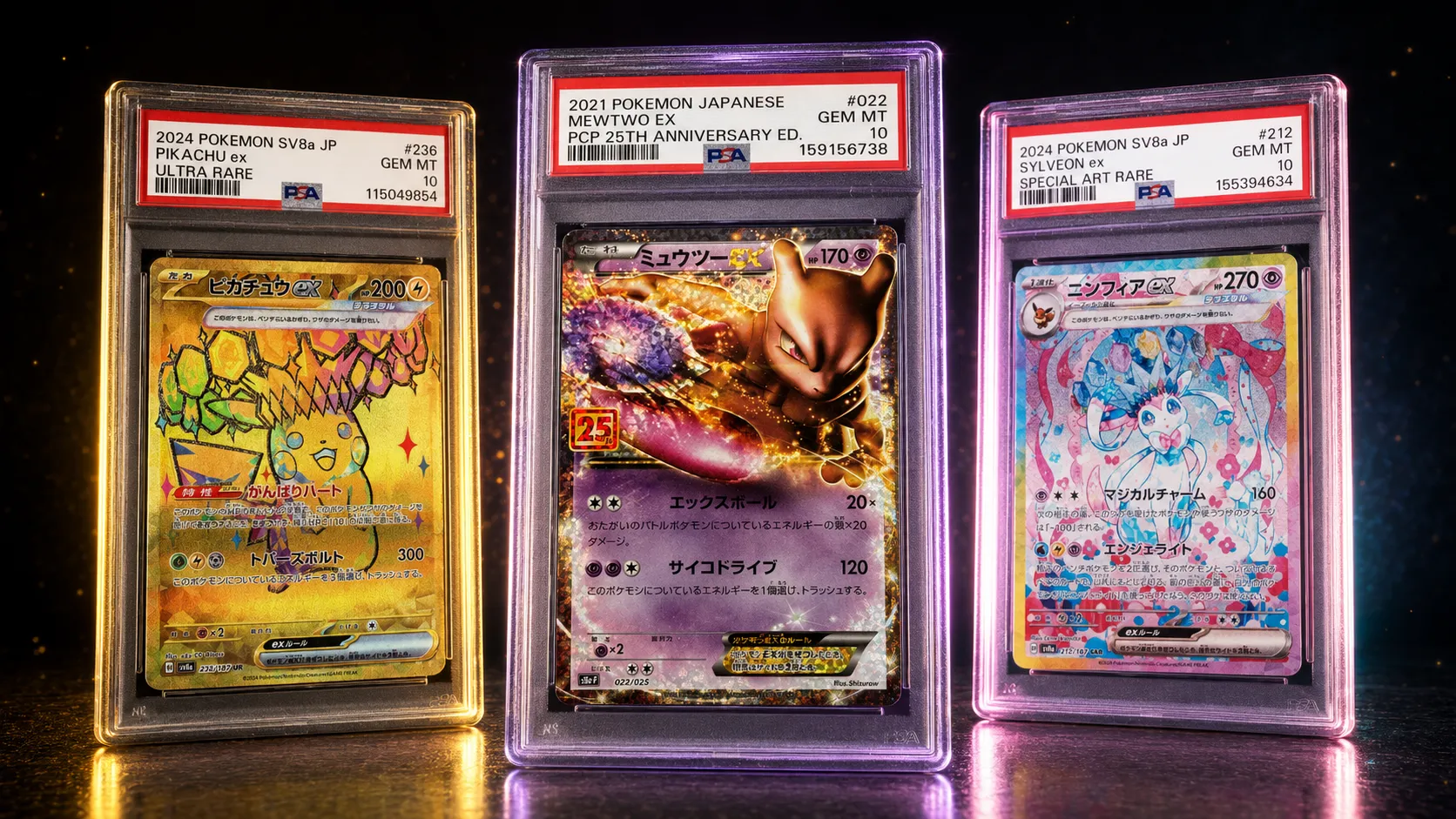
Japan also runs finishes that simply don’t appear in English sets: the Mirror Holofoil variation used on certain Japan-exclusive products (for example the Pikachu from the S8a 25th Anniversary Collection) flows on marketplaces like TCGplayer as its own “Pokémon Japan” product line, separate from anything in the English catalog [3].
One honest limitation. You’ll often read that Japanese card stock is thinner and glossier, or that English stock is heavier and more matte. It’s true that the English and Japanese versions are handled by different regional arms of The Pokémon Company — the company’s own support page states that Pokémon Company International prints English, French, Italian, German and Spanish cards in either the United States or the European Union, while The Pokémon Company in Japan prints and supports additional languages including Japanese [21] — but we could not find an official source that publishes card-stock thickness or gloss specs to back a “which feels better” verdict — the specific comparisons all trace back to resale and affiliate blogs. So we’re leaving that claim out rather than repeating it as fact.
Rarity systems: why “UR” means two different things
This is the single most confusing part of crossing over, and it’s worth slowing down for. Japanese and English use different rarity vocabularies, and one abbreviation — UR — points at different tiers depending on which language you’re holding. Here is the core mapping:
| Japanese rarity | English equivalent | English symbol (Scarlet & Violet series) |
|---|---|---|
| AR (Art Rare) | Illustration Rare (IR) | single gold star |
| SAR (Special Art Rare) | Special Illustration Rare (SIR) | double gold star |
| SR (Super Rare) | Ultra Rare | double silver star |
| UR (Ultra Rare) | Hyper Rare | triple gold star |
Reading that table row by row (these are practical, broadly-corresponding pairs rather than exact one-to-one equivalents): Japan’s AR (Art Rare) is the rough counterpart of what English collectors call an Illustration Rare — Bulbapedia’s English rarity article even defines Illustration Rare as the rarity used “outside of Asia,” explicitly distinguishing it from the Asian (including Japanese) naming [4]. Likewise Japan’s SAR (Special Art Rare) broadly corresponds to the English Special Illustration Rare, a Scarlet & Violet-era rarity marked with a double gold star [5].
The two rows that catch people out are the last two. Japan’s SR (Super Rare) is the cognate of the English rarity called Ultra Rare [6]. And Japan’s UR (Ultra Rare) — the fully gold, all-over-decorated “gold card” — broadly corresponds to the English Hyper Rare (the triple-gold-star tier) [7]. So the letters “UR” on a Japanese card and the words “Ultra Rare” on an English card are not the same tier: the English “Ultra Rare” is closer to Japan’s SR, while Japan’s “UR” lines up with English Hyper Rare. This alignment is the Scarlet & Violet-series one, though — Bulbapedia notes the match doesn’t fully overlap across generations: in the Sword & Shield Series and earlier, the Japanese Ultra Rare tier lined up more with the English Secret Rare than with Hyper Rare, so treat the table as the current-generation mapping rather than an all-time rule [7].
For reference, the Scarlet & Violet-series English rarity symbols run: a double black star for Double Rare, a double silver star for Ultra Rare, a single gold star for Illustration Rare, a double gold star for Special Illustration Rare, a triple gold star for Hyper Rare, and a magenta star for ACE SPEC Rare [8]. Note this is not the full 2026 picture: the Mega Evolution series now underway has added further tiers on top — English Mega Hyper Rare (Japanese Mega Ultra Rare, MUR) [19] and Mega Attack Rare (Japanese MA) [19a]. If you buy Japanese singles by the rarity letters you’re used to seeing on English cards, the mapping above is the one worth bookmarking — it’s an easy way to overpay or underpay by mistaking a tier — but check the newest sets for the Mega-era symbols too. Those two Mega-era tiers are also where the price gap between printings is widest, and it does not point the same way at both: across seven Pokémon we priced on both sides, the Japanese alternate art was usually the cheaper buy while the English gold usually was — see Japanese vs English Mega ex: the cheaper printing depends on tier.
Sets and release timing
Japanese expansions often precede their international counterparts, and the English release tends to be a re-cut of the Japanese material rather than a straight translation on the same schedule. The gap has narrowed enormously over time. The very first Base Set launched in Japan on October 20, 1996, but didn’t reach English until January 9, 1999 — a lag of about two years and two months [9]. By the Scarlet & Violet era the gap was down to a couple of months: Japan’s Scarlet ex / Violet ex sets released January 20, 2023 [10a], and the English “Scarlet & Violet” base set followed on March 31, 2023 [10b].
The trickier part is that Japanese and English sets don’t line up one-to-one, and the mapping isn’t always “one Japanese set = one English set.” The Japanese high-class pack VSTAR Universe (released December 2, 2022) doesn’t have a single direct English counterpart released on the same day — its closest English equivalent is Crown Zenith (January 20, 2023), which compiles cards from VSTAR Universe and the VSTAR Special Set, plus cards from Japan’s Paradigm Trigger expansion and Incandescent Arcana subset that hadn’t already been included in the earlier English set Silver Tempest [11]. The confusing part is the direction of travel: some cards that had already been localized in Silver Tempest (November 11, 2022) originated in earlier Japanese expansions and were later reprinted in VSTAR Universe — so it’s not that a high-class pack’s contents were split forward into English, but that Crown Zenith drew heavily from VSTAR Universe while some of the same cards had reached English earlier by another route. The reverse pattern now happens too: the Japanese pair Black Bolt and White Flare (released June 6, 2025) came to English as the corresponding split expansions, also titled Black Bolt and White Flare, on July 18, 2025 — noted as the first time the English side adopted Japan’s “two simultaneous split sets” format, described as “the first of its kind in English and other Western markets” (though the Japanese and English set lists aren’t a perfect card-for-card match) [12]. The practical upshot for a collector: a card’s Japanese set and its English set can have different names, numbers, and set codes even when the artwork is identical — so search by the card, not the set, when you cross over.
Tournament legality and card backs
If you play as well as collect, this is the difference that matters most — but it’s worth being precise, because the rule is narrower than “Japanese cards are banned abroad.” The official Play! Pokémon TCG Tournament Handbook (revised May 21, 2026) sets an approved-language list for Championship Series events, which varies by region (for example, Canada’s list includes French alongside English, and several other regions have their own approved languages beyond English) — and Japanese does not appear on any of those region lists outside Japan. So for the competitive Championship Series circuit, Japanese cards generally can’t be played outside Japan [13]. For all other tournaments and League play, though, the same Handbook leaves the choice of legal languages to the discretion of the Organizer or League staff — so whether Japanese cards are welcome at a local event genuinely depends on who’s running it [13].
There is an exception worth knowing precisely. At premier events — the World Championships, International Championships, and Regional/Special Championships (and their side events) — players may, regardless of where the event is held, use English cards or cards in any language that is tournament-legal in their own home country [13]. That’s how, for example, a player from Japan can bring Japanese cards to Worlds — not because Japanese becomes universally legal, but because it’s legal in their home country.
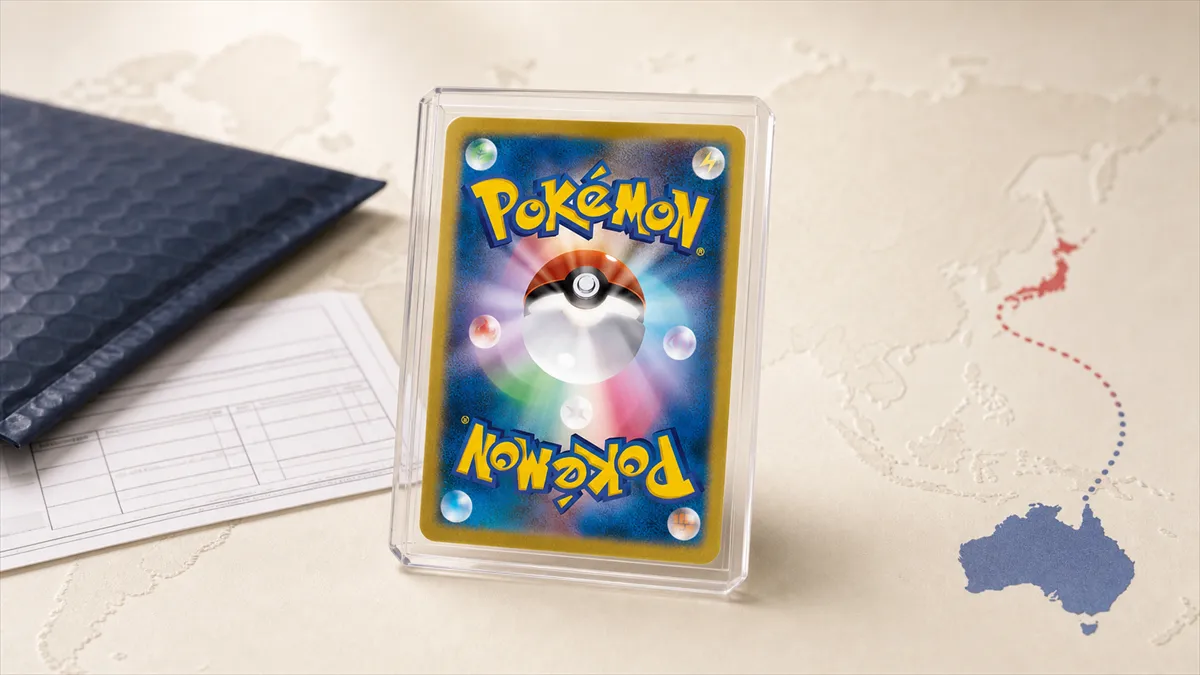
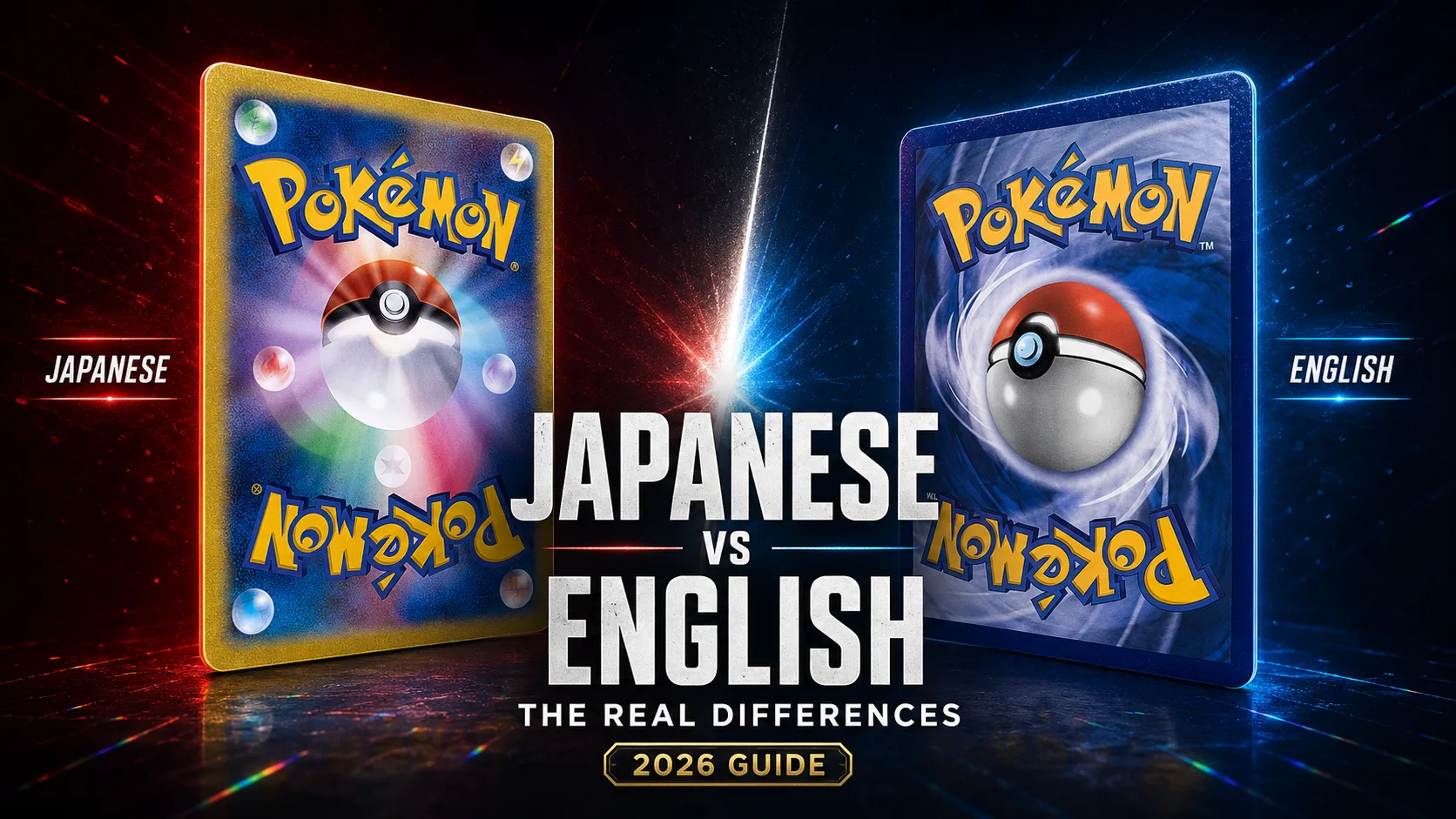
One physical fact sits underneath this: Japanese cards use a different card back from every other Pokémon TCG card, and the official Tournament Handbook treats them as “marked” cards for that reason — i.e. distinguishable from the rest of a deck by their back alone, which is why a deck mixing Japanese and non-Japanese cards has to be sleeved in opaque sleeves [13]. (The language-legality lists above are a separate rule; we’re not claiming the different back is the sole reason for those.) None of this affects collecting or display; it’s specifically about competitive play.
Grading: Japanese and English are tracked separately
A grading company evaluates a Japanese card on the same physical criteria as any other — centering, corners, edges, and surface, among other factors like gloss and print quality — and yes, PSA’s own published grading standards are not language-specific, so a Japanese card is graded on the same 10-point scale, using the same criteria, as an English one [18]. If you’re weighing whether and how to grade a Japanese card, we’ve written that up in detail separately: see our guide to getting Japanese Pokémon cards graded by PSA.
The structural difference relevant here is that the two are counted as separate populations. PSA’s public population report catalogs Japanese cards under their own category names and IDs — a “Pokémon Japanese Promo” category, for instance, sits apart from the English equivalents — so a Japanese and English version of the same card are usually listed as separate populations rather than pooled into one count [15].
What we won’t claim. You’ll see confident statements that Japanese cards hit PSA 10 more often, or that centering standards differ by region. We could not find a PSA or otherwise-neutral source that publishes a gem-rate or centering-yield comparison between Japanese and English cards — every version of that number we found came from resale or affiliate blogs. So we’ll state only what’s verifiable: PSA usually lists the two as separate categories. Any specific percentage gap is not something we can source, and we’re not going to invent one.
Pricing: two separate market series
The clearest, most defensible thing to say about price is structural: at least one major price tracker lists Japanese and English versions of a card as separate series. PriceCharting — a commercial third-party price guide (it runs its own marketplace and derives prices partly from eBay sold-listing data, so “neutral” would overstate it [20]) — maintains its own product categories and price pages for Japanese sets, “Pokémon Japanese Promo,” “Pokémon Japanese Go,” “Pokémon Japanese Web,” and so on, kept distinct from the English catalog [16]. That at least tells you PriceCharting itself doesn’t treat the two as interchangeable.
On the question everyone actually wants answered — is Japanese cheaper or more expensive than English? — the honest answer is: it depends on the card and the moment, and there is no single direction that holds across the board. Because they trade as separate series, the same character can run higher in one language and lower in the other depending on the specific card, its rarity tier, and timing. We’re not going to attach a “Japanese is X% cheaper” figure to that, because we could not source one to neutral market data. What we can point you to is our own card-by-card tracking, where we follow individual Japanese singles over time with dated, sourced numbers — for example our price watches on the Japanese Mewtwo AR (Pokémon 151) and the Japanese Charizard ex SAR (Shiny Treasure ex), and one article where we compare a specific Japanese card’s price directly against its English counterpart, the Mega Lucario ex SAR. Those are where concrete, dated price figures live — this hub deliberately stays qualitative because the general claim can’t be sourced as a number.
Japan-exclusive cards and authenticity checks
Part of the appeal of Japanese cards is that some of them simply never had an English release, or were changed when they did. TCGplayer’s Japanese FAQ makes the general point that some cards, sets, promotions, and finishes are Japan-only and have no English equivalent at all [14] — and the VSTAR Universe / Crown Zenith / Silver Tempest reshuffling above shows how, even when cards do cross over, a Japanese product’s contents can be re-cut across different English sets rather than carried over intact [11]. There are also older Japan-only distributions — the region-varying “Lucky Stadium” cards handed out to entrants of Japan’s World Challenge Summer 2000 tournaments, with eight prints each exclusive to a Japanese region [17], or the Pokémon Card Fan Club prize cards such as Porygon, which club members could exchange 700 points for between April 2000 and December 2002 [19b].
Because Japanese cards don’t map one-to-one onto English ones, TCGplayer’s Japanese FAQ makes the point that the same illustration can differ between the two versions in edition, card number, rarity, finish, and set code — a good reminder to verify exactly which printing you’re buying [14]. That’s exactly why honest, unedited photography of the actual card matters when you buy Japanese singles sight-unseen from overseas — though a photo is only one input. The listing’s card number, set code, rarity, finish, condition notes and (if graded) the cert number are all part of confirming you’re getting the exact printing you think you are; no single photo proves authenticity on its own. If you’re in Australia and past the “should I collect Japanese cards” stage, our guide to shipping, customs, and GST covers what actually happens once you place an order.
Looking to try Japanese singles?
JariseStore sources its cards in Japan and photographs each listing individually — so you can look at the print alignment, edges, and holo pattern on the specific card a listing shows before you buy.
Delivery estimate: transit is approximately 1–3 weeks after dispatch; please allow up to 4 weeks.
FAQ
Are Japanese Pokémon cards tournament-legal outside Japan?
It depends on the event. For the official Championship Series, no: those events list legal card languages by region, and Japanese isn’t on any region’s list outside Japan [13]. For all other tournaments and League play, though, the Handbook leaves the legal languages up to the Organizer or League staff — so a local event may well allow them; ask the organizer [13]. And at premier events (Worlds, Internationals, Regional/Special Championships), players may use cards in a language that’s legal in their own home country — so a Japan-based player can bring Japanese cards there. For everyday collecting and display, none of this applies.
What does “UR” mean on a Japanese card versus an English one?
On a Japanese card, UR (Ultra Rare) is the fully gold, all-over-decorated “gold card.” For Scarlet & Violet-series cards it broadly corresponds to the English Hyper Rare (the triple-gold-star tier) [7]. The English rarity called “Ultra Rare” is a different tier — it lines up more with the Japanese SR (Super Rare) [6]. In short, the same letters point at different tiers depending on the language (and the correspondence shifts by generation), so it’s worth double-checking which one a listing means.
Are Japanese cards worth more than English cards?
There’s no single answer, and we won’t pretend there is. Japanese and English versions trade as separate price series — PriceCharting keeps distinct categories and price pages for Japanese sets [16] — and the same card can run higher or lower in one language than the other depending on the card, its rarity, and the timing. We couldn’t source a reliable “Japanese is X% cheaper/pricier” figure to neutral market data, so we don’t quote one. For concrete, dated numbers on specific cards, see our card-by-card price watches.
Can PSA grade a Japanese card the same as an English one?
Yes — PSA’s published grading standards aren’t language-specific, so Japanese cards are graded on the same 10-point scale and the same criteria (centering, corners, edges, surface) as English cards [18]. Grading companies do, however, track Japanese and English cards as separate population categories [15]. If you’re thinking about submitting one, our full walkthrough is here: Can PSA grade Japanese Pokémon cards?
Do Japanese cards look different from English cards, apart from the language?
Yes, in a few concrete ways. On cards using the Sheen holo finish, the diagonal refraction runs the opposite direction on Japanese cards versus the international print [2] — and Japanese cards use a distinct card back from every other Pokémon TCG card [13]. We’re careful not to claim one has thicker stock or better gloss than the other, because we couldn’t find an official source that publishes those specs.
Methodology & data sources
The factual claims in this guide are drawn from public reference material, each linked at the point it’s used and checked July 23, 2026: Bulbapedia for holo patterns, rarity mappings, and set details [1] [2] [4] [5] [6] [7] [8] [9] [11] [12]; a TCGplayer product listing for the Mirror Holofoil example [3]; Bulbapedia again for the Mega Evolution-series rarities [19] [19a] and the Japan-exclusive Lucky Stadium [17] and Fan Club Porygon [19b] distributions; The Pokémon Company’s own country-of-origin support page for where each language is published [21]; Bleeding Cool for the Japanese Scarlet ex / Violet ex release date [10a] and PokéBeach for the English Scarlet & Violet release timeline [10b]; the official Play! Pokémon TCG Tournament Handbook (revised May 21, 2026) for language legality and “marked”-card handling [13]; TCGplayer’s official Japanese Pokémon FAQ for edition/numbering/rarity differences between same-illustration cards [14]; PSA’s population report for separate-category tracking [15] and PSA’s published grading standards for the same-scale/same-criteria claim [18]; and PriceCharting for its separate Japanese price categories [16], with its own methodology page noting it runs a marketplace and prices partly off eBay sold-listing data [20]. Several of these pages returned an access error to our automated fetch tool, so their content was confirmed via search-engine-indexed snippets of the same official URLs rather than a direct render — we flag that limitation rather than hide it. Unlike our market-category articles, this guide does not use JariseStore’s internal pricing or sales data; it’s a general comparison. We deliberately excluded specific PSA gem-rate / population-percentage claims and specific Japanese-vs-English price-premium figures, because we could not trace them to a neutral origin — every version we found came from resale or affiliate blogs, which we don’t use as sources. Several of our sources are not neutral primary references — Bulbapedia is a community-edited wiki, and TCGplayer and PriceCharting are commercial market sites; we’ve named the source type where it’s load-bearing rather than present all of them as authoritative. The rarity mapping reflects the Scarlet & Violet series; Bulbapedia notes the Japanese “UR”/English correspondence was different in the Sword & Shield Series and earlier, and the Mega Evolution series now underway (2026) has added further tiers, so the mapping is generation-dependent, not eternal.
About JariseStore
JariseStore is a Japan-based specialist in Japanese Pokémon single cards, shipping to collectors worldwide. We source our cards in Japan and photograph each listing individually rather than using stock photos, so the image is of the card that listing sells. Questions about a card or shipping? Reach out on Instagram @jarisestore.
Information shown reflects publicly available reference material as of July 23, 2026 and can change — tournament rules, set structures, and rarity conventions are all revised over time; always confirm current details with the original sources linked above. This article is for informational purposes only and is not investment advice. Pokémon and all card names are trademarks of their respective owners; JariseStore is an independent reseller and is not affiliated with The Pokémon Company.