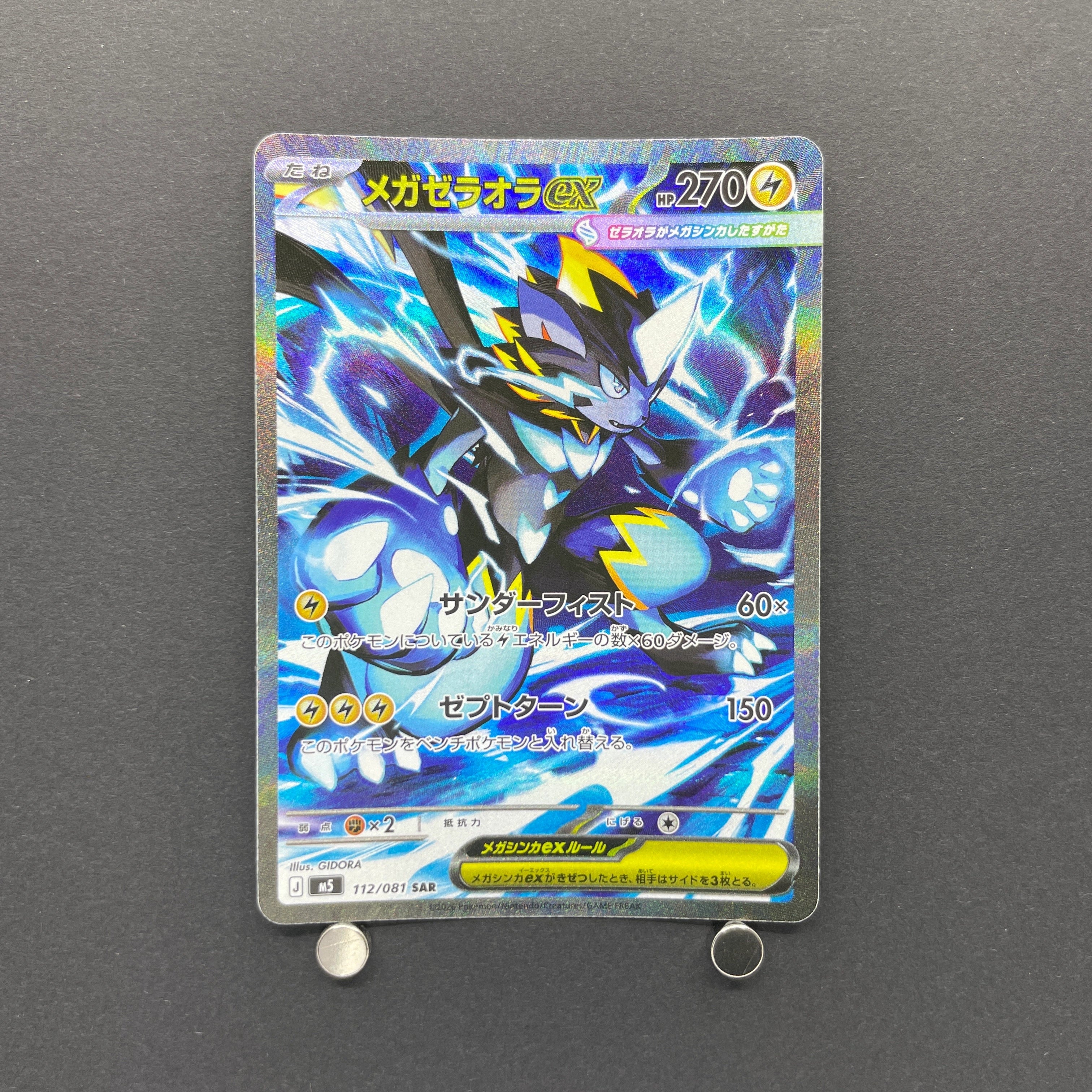
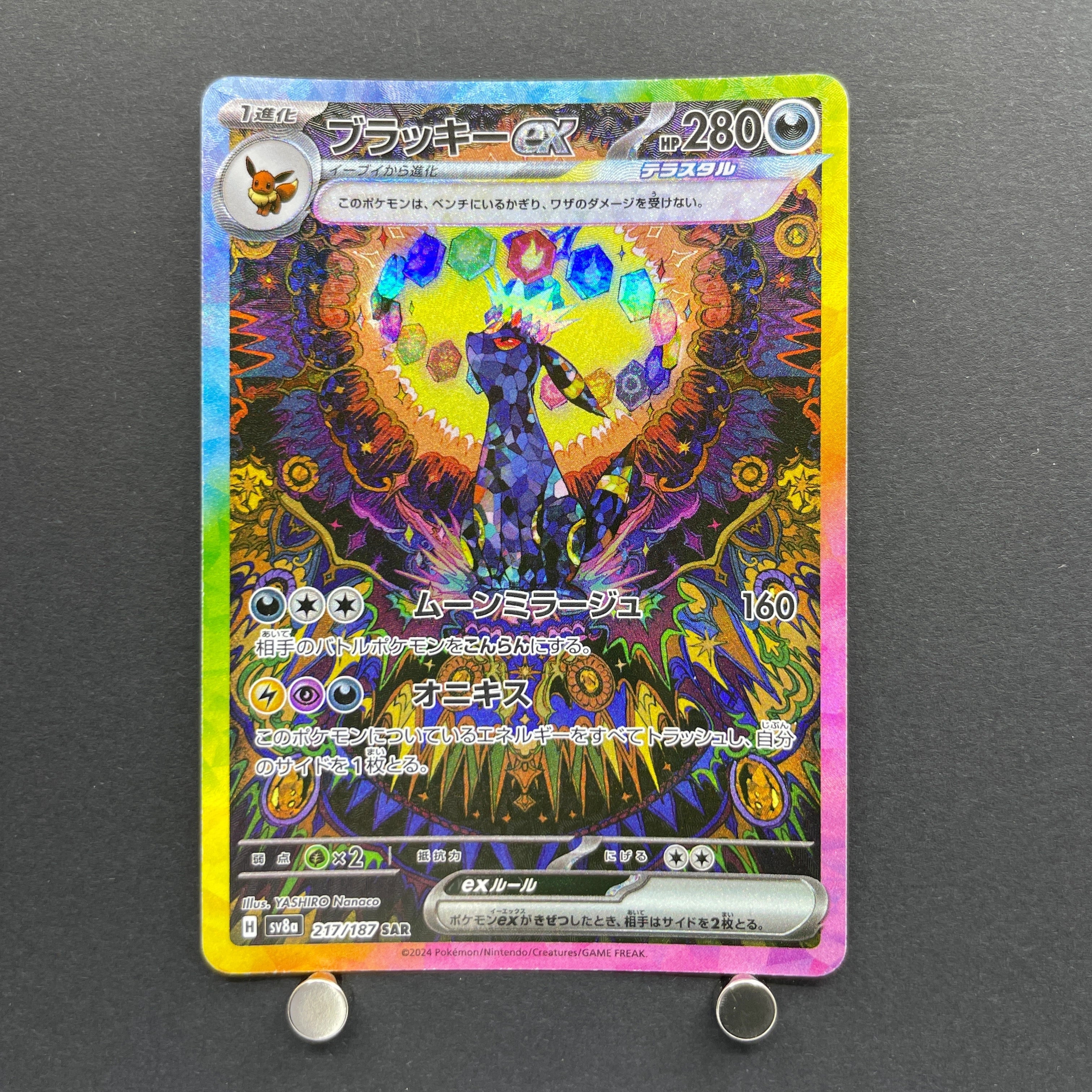
Japanese vs English Mega ex: The Cheaper Printing Depends on Tier
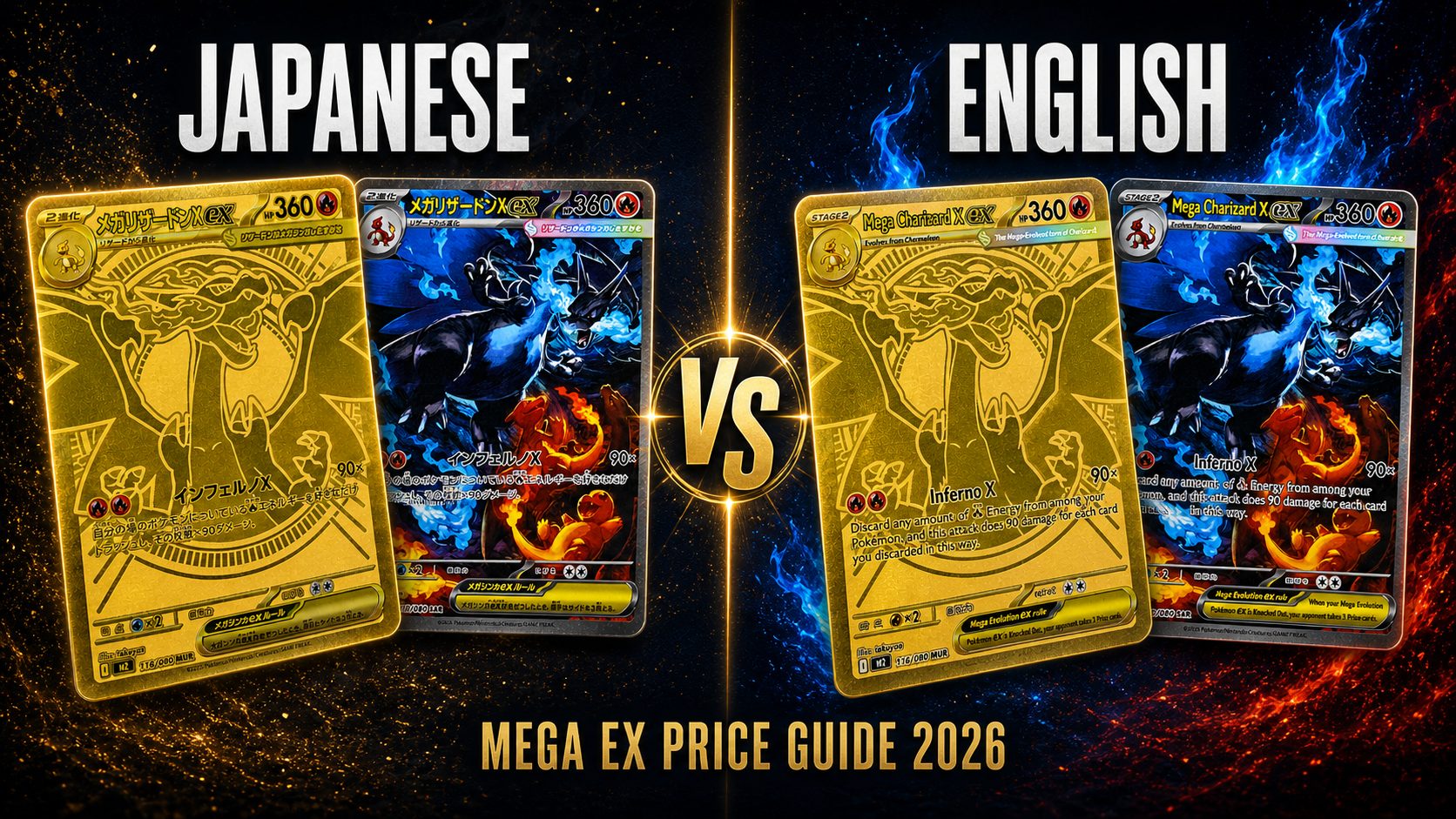
If you collect Mega-era cards, you have probably been told that Japanese printings are the cheaper way in. That is true at one tier and false at the other. Across the Mega ex we can price as matched pairs, the alternate art is usually cheaper in Japanese — and the gold card is usually cheaper in English.
Mega Dragonite ex shows both halves at once. Its alternate art is US$227.06 in Japanese against US$706.96 in English. Its gold card runs the other way: US$200.10 in Japanese against US$265.28 in English. Same Pokémon, same marketplace, opposite answers.
All prices are TCGplayer market price, Near Mint, in USD, captured between August 9 and 11, 2026. Both sides are the same marketplace — this compares Japanese-printed against English-printed cards in one market, not Japan against the West. See Methodology.
Across seven Mega ex, priced August 9–11, 2026.
The two tiers, in both languages
The Mega-era rarity ladder lines up one-for-one between Japanese and English. Only the names change.
| Tier | Japanese | English |
|---|---|---|
| Main set | Double Rare (RR) | Double Rare |
| Full art | Super Rare (SR) | Ultra Rare |
| Alternate art | Special Art Rare (SAR) | Special Illustration Rare (SIR) |
| Gold | Mega Ultra Rare (MUR) | Mega Hyper Rare (MHR) |
This page is about the bottom two rows. One clarification before the numbers: the alt art and the gold are not the same illustration in two finishes. They are separate cards with separate artwork — in Japanese Mega Dragonite ex, the two are credited to different illustrators. What we compare is not a picture. It is where each printing’s price sits relative to the other tier.
The prices
Seven Mega ex exist as an alternate art and a gold card in both languages. In all seven, the gold commands more relative to its alt art in Japanese than in English.
| Pokémon | JP alt art | JP gold | JP ratio | EN alt art | EN gold | EN ratio |
|---|---|---|---|---|---|---|
| Mega Charizard X ex | US$713.40 | US$690.59 | 0.97 | US$732.40 | US$313.94 | 0.43 |
| Mega Darkrai ex | US$280.01 | US$479.75 | 1.71 | US$249.17 | US$173.64 | 0.70 |
| Mega Dragonite ex | US$227.06 | US$200.10 | 0.88 | US$706.96 | US$265.28 | 0.38 |
| Mega Gardevoir ex | US$123.33 | US$262.79 | 2.13 | US$194.92 | US$208.29 | 1.07 |
| Mega Greninja ex | US$316.73 | US$489.53 | 1.55 | US$211.73 | US$187.62 | 0.89 |
| Mega Lucario ex | US$94.92 | US$263.82 | 2.78 | ≈US$220 | ≈US$275 | 1.25 |
| Mega Zygarde ex | US$29.05 | US$174.03 | 5.99 | US$61.32 | US$131.47 | 2.14 |
Prices as tracked on August 9, 2026 (Japanese) and August 10, 2026 (English); both Mega Lucario ex rows on August 11, 2026. TCGplayer market price, Near Mint, USD. Ratio = gold ÷ alt art; above 1.00 means the gold is the pricier card. Median ratio: 1.71 Japanese, 0.89 English. The two Mega Lucario ex English figures are marked approximate because they were read manually from the marketplace rather than captured by our tracking — see Methodology.
Reading the rows: in English the gold trades below the alt art in four of seven. In Japanese it trades above in five of seven, and the two exceptions are near-ties — Mega Charizard X ex at 0.97 and Mega Dragonite ex at 0.88. There is no Pokémon here where the English market pays a bigger relative premium for the gold than the Japanese market does.
How much weight these numbers carry
Less than the decimal places suggest — and the Japanese gold prices are the thinnest of all.
TCGplayer’s market price is not a plain average — it weights recent completed sales and handles outliers — but however it is computed, it has to be computed from something. When very few sales feed it, it moves on almost nothing. Here is the count of completed sales over the trailing window for each card, on the same metric for both languages, as liquidity context for the prices above:
| Pokémon | JP alt art | JP gold | EN alt art | EN gold |
|---|---|---|---|---|
| Mega Charizard X ex | 9 | 11 | 268 | 233 |
| Mega Darkrai ex | 58 | 4 | 265 | 167 |
| Mega Dragonite ex | 117 | 30 | 185 | 165 |
| Mega Gardevoir ex | 51 | 6 | 207 | 97 |
| Mega Greninja ex | 71 | 13 | 962 | 433 |
| Mega Lucario ex | 74 | 4 | not retrieved | not retrieved |
| Mega Zygarde ex | 223 | 18 | 766 | 354 |
Completed sales over a rolling window of up to 90 days, retrieved August 11, 2026. Darkrai’s windows are shorter because ME05: Pitch Black and M5: Abyss Eye are recent releases. The English Mega Lucario ex figures could not be retrieved through our tooling, so its sale counts are unknown to us on that side.
Every Japanese gold price on this page rests on between 4 and 30 sales. The English golds we could measure rest on 97 to 433. That asymmetry matters for how you read the ratio column, because the Japanese gold is the numerator of the pattern this article is about. Mega Darkrai ex — one of the largest Japanese premiums at 1.71 — is built on four sales in three months. One unusual transaction moves it.
The direction of the finding survives this: it holds in seven of seven, with four Japanese ratios above 1.7, and it would be a strange coincidence for thin data to lean the same way seven times. The precise numbers do not survive it. Treat 1.71 and 0.89 as “clearly different”, not as measurements you could rebuild to the second decimal next week.
What might explain the gap
We do not know, and the honest version of this section is a list of candidates rather than an answer.
The temptation is to say scarcity explains it, or that it proves the two markets want different things. Neither claim is available from the data on this page, and it is worth being precise about why.
Pull rates: measured on one English set, and smaller than the number in circulation
TCGplayer opened more than 5,000 packs of ME01: Mega Evolution and reported that any Mega Hyper Rare appears about once per 1,260 packs, and any Special Illustration Rare about once per 101 packs. Those are tier-level odds, and they are widely repeated as though the gold were 12 times harder to pull than the alt art.
For a specific card, which is what a price refers to, the gap is much smaller. ME01 contains two Mega Hyper Rares and ten Special Illustration Rares, so — assuming the cards within a rarity are equally distributed — the odds of pulling the particular gold you want are about 1 in 2,520 packs, roughly 70 booster boxes, against about 1 in 1,010 packs, roughly 28 boxes, for a particular alternate art. That is about 2.5 times harder, not 12.
Treat both of those per-card numbers as rough. The 5,000-pack sample is large in total but produced very few golds, so the tier-level rate for Mega Hyper Rare carries real uncertainty before we divide it, and the equal-distribution assumption has not been tested.
Two limits on this. It was measured on ME01 only, so we do not carry it to ME02, ME03, ME04, ME05 or Ascended Heroes. And we have no pull-rate figure for the Japanese sets that we are willing to publish — the numbers in circulation come from shops that compete with us, and we do not republish competitors’ data. Without the Japanese side, the rarity ratio within Japanese cannot be computed at all, so rarity cannot be ruled out as an explanation. It simply cannot be tested here.
Pull rate is not supply anyway
Even with both sets of odds, how many copies exist in collectors’ hands depends on print runs and reprints, how many packs were actually opened rather than kept sealed, how the product was distributed by region, and how long the set has been out. Two cards with identical pull rates can have very different circulating supply. Pull rate is one input to scarcity, not scarcity itself.
Set structure sometimes differs
In every Mega-era Japanese set we track — M2: Inferno X, M2a: MEGA Dream ex, M3: Nihil Zero, M4: Ninja Spinner, M5: Abyss Eye, Mega Brave and Mega Symphonia — there is exactly one gold card. English ME01 has two, alongside ten Special Illustration Rares.
But this is not a general Japanese-versus-English difference, and we originally wrote it as though it were. Later English sets are not all built like ME01: several of them carry a single Mega Hyper Rare, which makes them structurally the same as their Japanese counterparts on this point. So “one apex versus two” describes ME01 specifically rather than English sets as a class, and it cannot explain a pattern that shows up in all seven pairs. It stays on this list as a possible contributor for the sets where it applies, nothing more.
What we cannot claim about collectors
You will find collectors on both sides describing the gold tier very differently — English-language posts arguing that gold has fallen out of fashion since its 2013 debut, Japanese-language posts treating the single Mega Ultra Rare as the card that defines a set’s value. Those are real opinions and they are worth reading, but they cannot be evidence here, because both price series on this page come from the same marketplace. Someone buying a Japanese-printed card on TCGplayer is usually not in Japan. To compare Japanese and English-speaking collectors properly you would need Japanese domestic sold data — Mercari, Yahoo! Auctions, shop listings — set against eBay and TCGplayer, and we have not done that here.
What this means if you are buying
Decide the tier first, then the language. Doing it the other way round costs money in both directions.
Across the seven pairs, the alternate art is cheaper in Japanese in five — sometimes by a lot. Mega Dragonite ex is US$227.06 against US$706.96; Mega Lucario ex is US$94.92 against roughly US$220; Mega Zygarde ex is US$29.05 against US$61.32. The exceptions are real: Mega Darkrai ex and Mega Greninja ex are both cheaper in English, and Mega Charizard X ex is within 3% either way, which is a tie.
The gold is cheaper in English in five of seven. Mega Darkrai ex is US$173.64 in English against US$479.75 in Japanese; Mega Greninja ex is US$187.62 against US$489.53. Mega Dragonite ex and Mega Lucario ex run the other way — and Lucario is close enough (roughly US$275 against US$263.82) to call level.
We sell Japanese singles, so we will say the uncomfortable half out loud: if what you want is the gold, you will usually pay less for the English printing, and you should go and buy it there. Where we are worth your time is the alternate-art tier and the Super Rare tier below it — that is where Japanese pricing is generally kinder, and it is what we stock and condition-check ourselves.
One practical note that follows from the sale counts above: on the thinly traded golds, a listed price is a weaker guide than usual. If you are buying at that end, look at what has actually sold recently rather than at the headline market price — in either language.
Japanese Mega-era singles
Sourced in Japan, individually photographed and honestly condition-checked, shipped worldwide with tracking.
Handed to Japan Post within 2 business days, tracked. Estimated transit: approximately 1–3 weeks after dispatch; please allow up to 4 weeks.
Set-by-set checklists with current prices: Abyss Eye (M5), Ninja Spinner (M4) and MEGA Dream ex (M2a), which covers the Japanese Mega Dragonite ex pair in this table alongside the other 55 secret rares in its set. For one card followed in depth across both languages, see our Mega Lucario ex SAR price watch. And if you are weighing Japanese against English more generally — print quality, sizing, how the rarity systems differ — start with Japanese vs English Pokémon cards.
FAQ
Is the Japanese version always cheaper?
No. It depends on the tier. Of our seven pairs the Japanese alternate art was cheaper in five, and the Japanese gold was cheaper in only two. Check the row for your Pokémon rather than assuming one language is broadly cheaper — it is not.
Is the Japanese gold card rarer than the English one?
We do not know. The English rate has been measured for ME01 — about 1 in 2,520 packs for a specific Mega Hyper Rare — but we have no Japanese figure from a source we are willing to cite, and the English measurement covers one set only. Anyone who tells you the two are equal, or that one is clearly rarer, is going beyond the published evidence.
Then why is the Japanese gold more expensive relative to its alternate art?
Honestly, we cannot say from this data. Relative rarity within each language, print volumes, how much of each set was opened, time since release, set structure and collector taste could all contribute, and the figures available to us cannot separate them. What we can show is the price pattern itself, consistently, across seven pairs.
How reliable are these prices?
The English figures rest on hundreds of sales each. The Japanese gold figures rest on between 4 and 30 sales over the trailing window, which is thin enough that individual transactions move them. The direction of the pattern is consistent across all seven pairs; the exact ratios are not precise. We publish the sale counts above so you can judge each row yourself.
Are the Japanese SAR and the English SIR the same card?
They are the same tier of the same Pokémon from corresponding sets. We have deliberately not claimed the artwork is identical across the pairs in our table: we could not retrieve illustrator credits for their English printings or compare the images from our editing environment. Where we have confirmed a shared illustration for a specific card, we say so — our Mega Lucario ex report is one such case.
Do these prices include graded copies?
No. Every figure here is for a raw Near Mint card. We hold PSA 10 medians for the Japanese side but not the English side, so publishing graded numbers would compare one market against nothing.
Methodology & data sources
Prices. Japanese figures come from our in-house daily tracking, which records TCGplayer market price for the Japanese printing in Near Mint condition; the snapshot is August 9, 2026. English figures were read from TCGplayer market price for the English printing in Near Mint condition on August 10, 2026. The Mega Lucario ex Japanese figures were retrieved on August 11, 2026. Both sides are Near Mint and USD, and that single measure is the only thing we place side by side. One marketplace, two printings. Japanese-printed cards trade on TCGplayer as their own product line, and most buyers there are not in Japan. Nothing on this page measures Japanese domestic prices, and no comparison here should be read as “Japan versus the West”. Market price is not a simple average. TCGplayer computes it from recent completed sales with its own outlier handling, so the sale counts below are published as liquidity context for each price, not as the inputs to an arithmetic mean. Sale counts. Completed sales over a rolling window of up to 90 days, on the same metric for both languages, retrieved August 11, 2026; windows are shorter for recently released sets. Scope. The seven pairs are every Mega ex that exists as an alternate art and a gold card in both languages and could be priced on both sides on these dates. Mega Lucario ex is the exception on method: our tracking database does not currently cover the Mega Brave gold card and our pricing tooling returns no market price for either English printing (SIR 179/132, MHR 188/132), so its Japanese figures were pulled from the marketplace directly and its English figures were read manually from TCGplayer on August 11, 2026 and are shown as approximate. Its English sale counts were not retrieved. Both gaps are ours to fix, and we flag the row rather than presenting it as equal in provenance to the others. Pull rates. The Pokémon Company does not publish pull rates. The ME01 figures come from TCGplayer opening over 5,000 packs, reported in September 2025: about 1 in 1,260 packs for any Mega Hyper Rare and 1 in 101 for any Special Illustration Rare. Those are tier-level odds; per specific card we divide by the number of cards in each tier (two Mega Hyper Rares and ten Special Illustration Rares in ME01), giving roughly 1 in 2,520 and 1 in 1,010. That division assumes cards within a rarity are equally distributed, which has not been tested, and the gold rate rests on few observed pulls even in a 5,000-pack sample, so the per-card figures are approximate. They apply to ME01 and we do not extend them to any other set. We publish no Japanese pull rate: the figures in circulation come from retailers who compete with us, and we do not republish competitors’ data. This means the rarity explanation is untested here, not disproved. Set composition. The count of one gold card in each of M2, M2a, M3, M4, M5, Mega Brave and Mega Symphonia comes from our own tracking as of August 11, 2026; our tracking covers the secret-rare tiers of these sets rather than every card in them. The ME01 breakdown comes from published English card lists. We do not claim English sets carry two golds as a rule — several later English Mega-era sets contain a single Mega Hyper Rare, so the ME01 structure is not a general English-versus-Japanese difference. Artwork. We make no claim that the alternate art and the gold share an illustration, or that Japanese and English printings of a tier share one. Prices are rounded for readability and move daily. Last updated: August 11, 2026.
About JariseStore
JariseStore is a Japan-based specialist in Japanese Pokémon single cards, shipping to collectors worldwide. Every card we sell is sourced in Japan, individually photographed, and honestly condition-checked. Questions about a card or shipping? Reach out on Instagram @jarisestore.
Prices reflect data available as of August 11, 2026 and can change quickly in the trading card market. This article is for informational purposes only and is not investment advice. Pokémon and all card names are trademarks of their respective owners; JariseStore is an independent reseller and is not affiliated with The Pokémon Company.