Mega Lucario ex SAR Price Watch: Japanese vs English at 58% Off (2026)
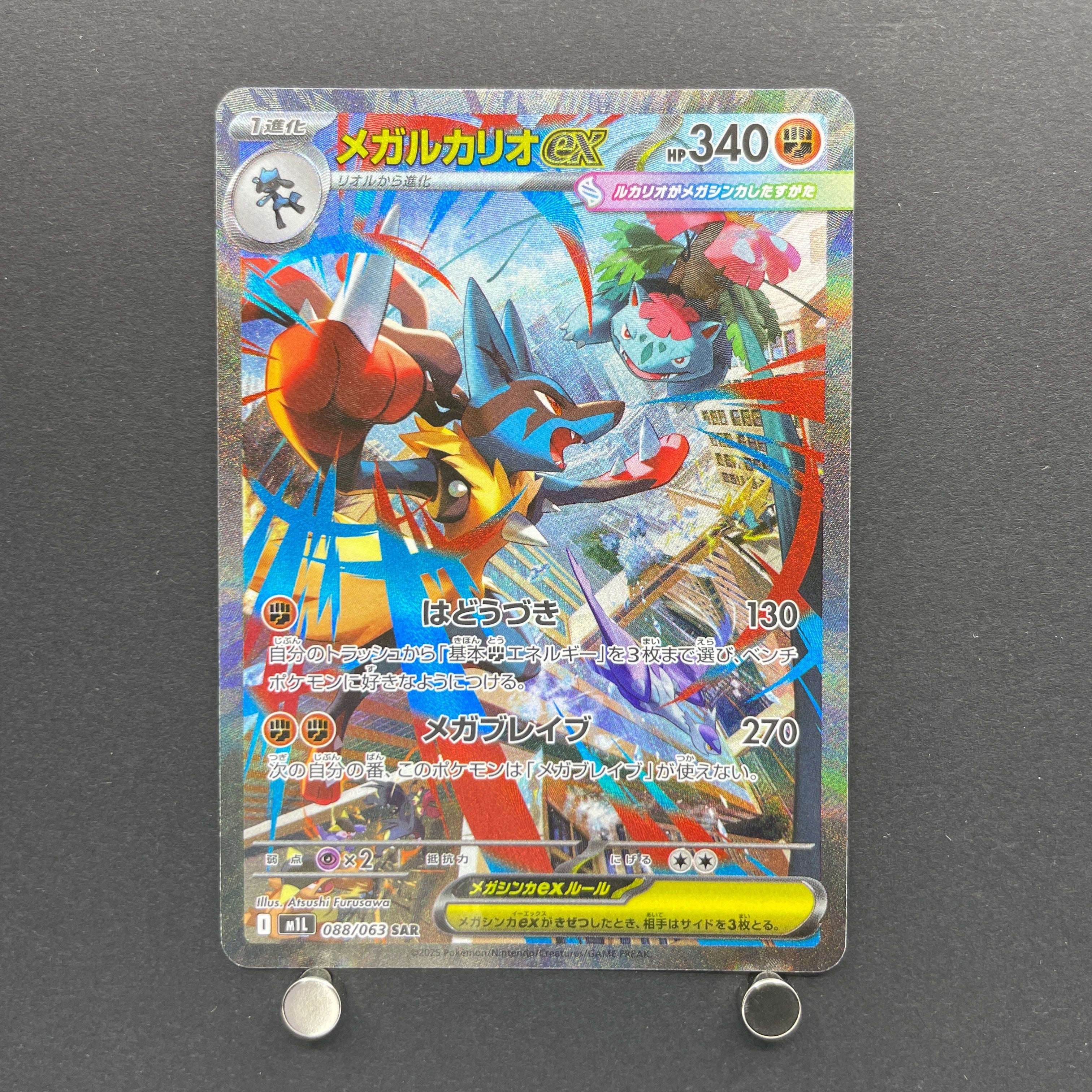
Every month we look at what collectors are actually searching for, viewing, and buying in our store — and cross-check it against live market prices. This month the signal is unmistakable: searches for “lucario” in our store more than tripled in two weeks, and they point at one card — the Japanese Mega Lucario ex SAR (088/063) from Mega Brave (m1L).
A quick note on how we report: this article deliberately combines two lenses — demand signals from our own store (what collectors search for and view at JariseStore) and market-wide prices and sales volumes that we track daily across the wider market. One shop’s data alone can mislead; together, the two views give you a much more reliable picture.
What is Mega Lucario ex SAR 088/063?
Released in Japan on August 1, 2025, Mega Brave (m1L) was one of the two sets that opened the Mega era of the Pokémon TCG — the first sets built around Mega Evolution ex cards, which hit hard and give up three Prize cards when knocked out. Mega Lucario ex is the set’s namesake headliner, and the SAR (Special Art Rare) version, 088/063, is its chase card: a full-art battle scene illustrated by Atsushi Furusawa.
Lucario has been a fan favorite for two decades — a regular in the games, movies, and Smash Bros. — and Mega Lucario is arguably its most iconic form. Nearly a year after the set launched, the card sits in an unusual spot: attention around Mega-era cards is climbing again as the English series rolls on (the fifth English Mega-era set, Pitch Black, launches July 17, 2026, and the next Japanese Mega expansion — Storm Emeralda, M6 — lands July 31), while the price of this Japanese SAR has been remarkably steady. That combination is what this report digs into.
Card profile
| Field | Value |
|---|---|
| Card | Mega Lucario ex |
| Number / Rarity | 088/063 · SAR (Special Art Rare) |
| Set | Mega Brave — m1L (Japanese), released Aug 1, 2025 |
| Game stats | Fighting · Stage 1 · Mega Evolution ex · HP 340 |
| Attacks | Aura Jab (130) · Mega Brave (270) |
| Illustrator | Atsushi Furusawa |
| English counterpart | Mega Evolution (ME01), SIR 179/132, released Sep 26, 2025 |
Price trend: holding steady while attention climbs
Our listing prices are pegged to the live market, so we track this exact card — the Japanese SAR printing — daily. Over the eleven days we’ve tracked it so far (July 6–16, 2026), the raw Near Mint market price has barely moved: US$95.15 → US$96.06, a change of +1.0% that is small enough to be noise. Zooming out with 90-day market metrics, the picture is the same: price momentum is roughly flat (about −0.4% per month).
Flat is not the same as dead. The same 90-day window shows 99 tracked raw sales — just over one sale per day — with around 32 active sellers, so this is a liquid, actively traded card, not a thin one. In plain terms: demand signals around Lucario are spiking (more on that below), but the price hasn’t reacted yet. Whatever happens next, a buyer today pays roughly what a buyer paid two weeks ago.
Daily tracking snapshot (raw Near Mint market price, USD)
| Date (2026) | Market price | Note |
|---|---|---|
| Jul 6 | US$95.15 | tracking start |
| Jul 8 | US$95.55 | |
| Jul 13 | US$96.40 | 11-day high |
| Jul 14 | US$96.06 | |
| Jul 16 | US$96.06 | latest |
Days where the price was unchanged are omitted (the latest day is always shown); the full series covers all eleven days, July 6–16, 2026. Source: JariseStore daily market price tracking (Japanese SAR printing).
Same artwork, 42% of the price: Japanese SAR vs. English SIR
Here is the number that makes this card worth a report. Furusawa’s artwork exists in two printings: the Japanese SAR (088/063, Mega Brave) and the English SIR (179/132, Mega Evolution). Same illustration, same full-art treatment. As of July 16, 2026, the Japanese printing trades at US$96A$137NZ$165C$135S$124AED 353 and the English one at US$229A$328NZ$394C$322S$296AED 841 — the Japanese card costs 42% of the English price, a gap of about US$133.
| Label | JPY | USD |
|---|---|---|
| Japanese SAR (m1L) | ¥15,569 | US$96 |
| English SIR (ME01) | ¥37,131 | US$229 |
Japanese SAR vs. English SIR (Near Mint, July 16, 2026)
| Japanese SAR 088/063 | English SIR 179/132 | |
|---|---|---|
| Set | Mega Brave (m1L) | Mega Evolution (ME01) |
| Market price | US$96.06 | US$229.09 |
| Tracked sales, last 90 days | 99 | 216 |
| Price for the same artwork | 42% | 100% |
Why the gap? The English market is simply bigger — more collectors, more graded-card activity, and a persistent premium for English-language cards. We don’t claim the gap must close; it may well persist. But it means one concrete thing today: the first printing of this artwork, from the set that started the Mega era in Japan, costs less than half of what the English version does. Note that the Japanese card is also the earlier printing — Mega Brave shipped almost two months before Mega Evolution. One caution about generalising from this card: the Japanese-is-cheaper gap is reliable at the alternate-art tier but not at the gold tier, where the English printing was the cheaper buy in five of the seven pairs we compared — see Japanese vs English Mega ex: the cheaper printing depends on tier. Mega Lucario ex itself shows the split cleanly. Its Japanese gold, Mega Ultra Rare 092/063, was US$263.82 on August 11, 2026 against US$94.92 for the SAR above — so the gold carries a 2.8× premium in Japanese, against roughly 1.25× for the English pair.
How we list this card: when we carry this exact SAR, copies are individually photographed — including any flaws, like a surface scratch on an LP copy — so you can see exactly what you’re buying. LP copies are typically priced below the Near Mint market average, and our prices are pegged to the live market and updated regularly. Browse current Lucario listings → Follow @jarisestore for restock alerts.
Raw vs. PSA 9 vs. PSA 10: the ladder has a surprise
Graded prices for this card don’t behave the way most people assume. Here is the ladder as of July 16, 2026:
| Label | JPY | USD |
|---|---|---|
| PSA 9 | ¥11,832 | US$73 |
| Raw NM | ¥15,569 | US$96 |
| PSA 10 | ¥32,415 | US$200 |
Raw vs. graded (Japanese SAR 088/063, July 16, 2026)
| Tier | Price | Sample |
|---|---|---|
| PSA 9 (sold average) | US$73.00 | 19 tracked sales |
| Raw, Near Mint (market price) | US$96.06 | 99 sales / 90 days |
| PSA 10 (sold average) | US$200.00 | 103 tracked sales |
- A PSA 10 pays: about 2.1× raw. PSA 10 copies sell for around US$200 against a US$96 raw price, on a thick sample of 103 tracked sales — and the PSA 10 trend in our dataset is currently flagged as rising (median US$156.64, average pulled up by stronger recent sales).
- A PSA 9 doesn’t: it trades below raw. At around US$73, a PSA 9 sells for less than an ungraded Near Mint copy. One caveat in fairness: the PSA 9 sample is thin (19 sales) and the average moved from US$85.75 to US$73.00 in a single update this week — but even at its higher reading, a PSA 9 was still worth less than raw.
The practical takeaway: grading this card only makes sense if you’re confident the copy can gem. Send a US$96 card off with grading fees on top, get a 9 back, and you own a US$73 card. This pattern — modern Japanese cards where only the 10 pays — is something we’ve written about before; see the raw-to-PSA 10 gap analysis in our Gengar & Mimikyu GX price watch for how to read these gaps.
What our store data shows: a genuine Lucario moment
We sell Japanese single cards to collectors worldwide, and we track (anonymously and in aggregate — never at the level of individual customers) which cards people search for and view. Around this card, three signals lined up in July.
1. “lucario” searches more than tripled
In the last 14 days (July 2–15), visitors typed “lucario” into our store search 31 times, up from 9 in the previous 14 days (+244%) — with a clear burst of 3–8 searches per day between July 9 and July 14. It wasn’t an isolated spike either: new Mega-era search terms (“mega clefable”, “mega kangaskhan”, “mega zygarde”, “mega gengar ex sar”) appeared in our logs the same weeks, which matches the timing of the English Mega series’ fifth set. Mega-era attention is broad right now — our Mega Darkrai ex SAR price watch covers the card leading that wave. (Mega Kangaskhan ex, another of those brand-new search terms, made our weekly cards-to-watch list.)
2. Views of this card went from single digits to the 20s and 30s
Weekly views of our Mega Lucario ex SAR listing rose from 5–9 per week in early June to 21–32 per week from mid-June onward. That’s sustained attention holding for a month, not a one-day blip.
| Label | Value |
|---|---|
| Jun 1 | 5 |
| Jun 8 | 9 |
| Jun 15 | 27 |
| Jun 22 | 21 |
| Jun 29 | 25 |
| Jul 6 | 32 |
| Jul 13* | 4 |
3. Lucario buyers are active, across printings
Interest is converting, too: across all Lucario singles in our store (the m1L SAR, SR, and RR printings, plus the Mega Dream MA), three copies sold in the last five weeks — two of the MA printing and one SR. To be fully transparent: none of those three was this SAR, whose listings haven’t turned over in that window — which is also why the LP copy we mention in this article is still listed. Quiet cards don’t sell three copies in five weeks; reported in aggregate only, as always.
Buying raw, and why condition photos matter for a SAR
Here’s where the PSA 9 finding above changes how you shop. Since a 9 trades below raw, the smart plays for this card are simple: either buy a raw copy you’re happy to keep raw, or — if you’re chasing the US$200 PSA 10 — buy only a copy whose surfaces and edges you’ve actually inspected. (Going the submission route? Our PSA grading guide for Japanese cards walks through fees, declared value, and packing.) SAR cards have textured, full-art surfaces where scratches hide from head-on photos; they need angled light to show.
That’s exactly how we photograph. At JariseStore every card is checked and classified into four grades — NM, LP, MP, HP — and every flaw we find is documented in the listing photos. No stock images: the photo in the listing is the exact card you’ll receive. Our current Lightly Played copy is a good example — it’s LP because of one surface scratch, and you can see that scratch in the photos and judge it yourself before buying.
Mega Lucario ex SAR 088/063 (Mega Brave m1L)
The Mega era’s first chase card, at the Japanese price
Authentic Japanese Mega Lucario ex SAR from Mega Brave m1L — individually photographed, honestly graded, shipped from Japan with tracking within 2 business days.
Delivery: estimated transit approximately 1–3 weeks after dispatch; please allow up to 4 weeks. Prices are pegged to the live market and updated regularly.
Sold out? Stock moves fast on trending cards — new copies are added regularly, and you can follow @jarisestore to catch restocks first.
FAQ
What set is Mega Lucario ex SAR from?
The Japanese version is card 088/063 (SAR, Special Art Rare) from Mega Brave (m1L), released in Japan on August 1, 2025 as one of the two sets that opened the Mega era. The artwork is by Atsushi Furusawa.
Is the Japanese SAR the same as the English SIR?
Same artwork, different printing. The Japanese SAR (088/063, Mega Brave) is the original, earlier printing; the English SIR (179/132, Mega Evolution) followed on September 26, 2025. As of July 16, 2026 the Japanese printing trades at about 42% of the English one — US$96 vs. US$229 — for the identical illustration.
Is grading Mega Lucario ex SAR worth it?
Only if you’re confident of a PSA 10. Our tracking as of July 16, 2026 shows PSA 10 copies selling around US$200 (2.1× the US$96 raw price), but PSA 9 copies around US$73 — below raw. Add grading fees and shipping, and anything short of a 10 loses money. That’s why inspecting a raw copy’s actual condition photos before buying matters so much.
How do I buy Japanese Pokémon cards from Japan?
The short version: order from a Japan-based specialist that ships internationally. At JariseStore, every order ships from Japan within 2 business days with tracking; estimated delivery is 1–2 weeks to Australia, 1–3 weeks to the US, and 1–4 weeks elsewhere. Every card is individually photographed and condition-graded, so what you see is exactly what arrives.
Methodology & data sources
Search and page-view figures come from our own site analytics, aggregated over the stated windows (searches: June 18 – July 15; weekly views: June 1 – July 15, 2026). Sales figures from our own store are reported only in aggregate; we never publish customer-level information. Market prices and sales counts come from our in-house daily tracking of live market prices and sold graded listings across the international marketplaces where this card actively trades; the daily price series covers July 6–16, 2026, and 90-day liquidity metrics are as of July 15, 2026. “Sold average” figures are outlier-adjusted averages of tracked graded sales; the PSA 10 median is reported alongside for context. All tracking follows the Japanese SAR printing (088/063) except where the English SIR (179/132) is explicitly compared. Prices shown in your currency are converted at official reference exchange rates of July 15, 2026 — the most recent published reference rate at the time of writing; USD figures are the original source values. Figures are rounded for readability. Last updated: July 16, 2026.
About JariseStore
JariseStore is a Japan-based specialist in Japanese Pokémon single cards, shipping to collectors worldwide. Every card we sell is sourced in Japan, individually photographed, and honestly graded — no surprises, what you see is what you get. Questions about a card or shipping? Reach out on Instagram @jarisestore.
Prices and trends shown reflect data available as of July 16, 2026 and can change quickly in the trading card market. This article is for informational purposes only and is not investment advice. Pokémon and all card names are trademarks of their respective owners; JariseStore is an independent reseller and is not affiliated with The Pokémon Company.