Japanese Charizard ex SAR 349/190: Raw Price Up, PSA 10 Cools
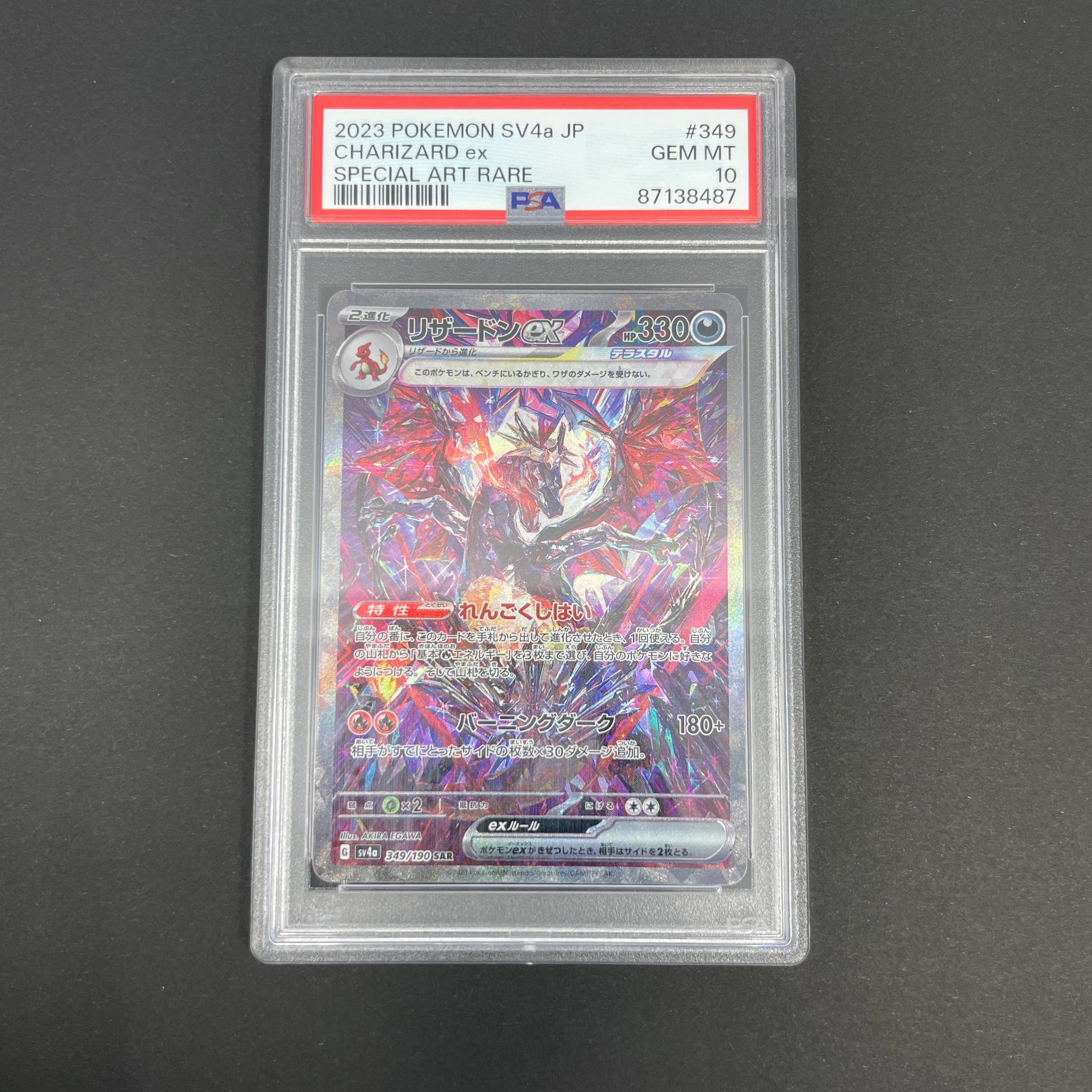
“Charizard” is the single most-searched card name in our store — and every month we check whether that search demand is landing on any one card in particular. This month it is: the Japanese Charizard ex SAR (349/190) from Shiny Treasure ex (SV4a) went from zero product-page views to a steady climb in the space of three weeks. Here’s what our first-party data and daily market tracking say about it.
A quick note on how we report: this article deliberately combines two lenses — demand signals from our own store (what collectors search for and view at JariseStore) and market-wide prices and sales volumes that we track daily across the wider market. One shop’s data alone can mislead; together, the two views give you a much more reliable picture.
What is Charizard ex SAR 349/190?
Shiny Treasure ex (SV4a) is one of the most internationally recognized Japanese Pokémon sets of the modern era — its “shiny Pokémon” gimmick and deep chase-card list made it a favorite well outside Japan. Charizard ex is the set’s headline chase card, and the SAR (Special Art Rare) printing, 349/190, is a full-art illustration by Akira Egawa — the same illustrator behind the Mega Darkrai ex SAR we covered in a separate price watch.
Charizard itself needs no introduction: it’s been the single most-recognized Pokémon outside the games for three decades, and “Charizard” has been the top search term in our own store since we started tracking search logs. What this report digs into is narrower and more useful than “Charizard is popular” — it’s what has changed about this specific printing in the last few weeks.
Card profile
| Field | Value |
|---|---|
| Card | Charizard ex |
| Number / Rarity | 349/190 · SAR (Special Art Rare) |
| Set | Shiny Treasure ex — SV4a (Japanese) |
| Game stats | Fire · Stage 2 · Pokémon ex · HP 330 |
| Attack | Burning Darkness (180+) — deals 30 more damage for each Prize card the opponent has already taken |
| Weakness | Grass ×2 |
| Illustrator | Akira Egawa |
What our store data shows: a new card enters the picture
We sell Japanese single cards to collectors worldwide, and we track (anonymously and in aggregate — never at the level of individual customers) which cards people search for and view. For this specific SAR, two signals told two different parts of the same story.
1. “Charizard” searches peaked in late June, then cooled
”Charizard” is the single most-searched card name in our store: 187 searches between April 1 and July 16, 2026, ahead of every other card name we track. But the week-by-week pattern isn’t a straight line up — it’s a spike. Searches climbed from single digits in early June to a peak of 40 in the week of June 24–30, then eased back to single digits by the second week of July.
| Label | Value |
|---|---|
| Jun 3 | 3 |
| Jun 10 | 11 |
| Jun 17 | 13 |
| Jun 24 | 40 |
| Jul 1 | 32 |
| Jul 8 | 7 |
Being honest about this shape matters: a naive “last 14 days vs. previous 14 days” comparison would actually show a decline here, because the peak week falls in the earlier of those two windows. We’re showing you the real weekly pattern rather than picking a window that tells a cleaner story.
2. But views of this exact SAR kept climbing after the search spike faded
Here’s the more useful signal. While the generic “charizard” search term was cooling off, product-page views of this specific printing — the SAR 349/190 — kept accelerating. This card had zero page views in our store before June 29, 2026. Since then:
| Label | Value |
|---|---|
| Jun 24 | 7 |
| Jul 1 | 4 |
| Jul 8 | 14 |
| Jul 15* | 3 |
In total: 28 page views, 100% of them in the last four weeks, and the most recent 14 days (19 views) are already more than double the 14 days before that (9 views, +111%). One honest caveat, in the same spirit as our other reports: none of that attention has converted into a cart add or a sale for this exact SAR yet — at this price point, collectors research before they buy. Interest across other Charizard printings in our store has converted, though: eight Charizard cards across several different prints have sold in the same window, which is part of why we added this specific SAR to our daily market-price tracking on July 7. (That screening is the same process behind our weekly Japanese cards-to-watch list.)
Market price: a steady 3-month climb, though the pace has eased
We track this exact printing — the Japanese SAR, not the Shiny Secret Rare or other Charizard prints in the same set — daily. Over the last three months the raw Near Mint market price has moved in one direction, almost without exception:
| Label | Value |
|---|---|
| Apr 18 | $191.13 |
| Apr 25 | $191.75 |
| May 2 | $196.55 |
| May 9 | $195.78 |
| May 16 | $201.76 |
| May 23 | $199.73 |
| May 30 | $202.21 |
| Jun 6 | $208.61 |
| Jun 13 | $209.64 |
| Jun 20 | $211.64 |
| Jun 27 | $213.47 |
| Jul 4 | $216.65 |
| Jul 11 | $218.50 |
| Jul 16 | $218.92 |
From US$191.13 to US$218.92 (most recently, July 16) — a rise of essentially no down weeks along the way. Our own daily tracking of this card only starts on July 7 (the point where its store-data momentum caught our attention); the April–early-July portion above comes from the market data provider we use for daily price snapshots, and we’ve kept that distinction clear rather than implying we personally watched this card for three months. Because our currency-conversion rate is fixed to July 15, the headline figures and stat tile above use the July 15 snapshot specifically (US$218.66, +14.4% from the April start) rather than the very latest tick.
Our own daily tracking window (raw Near Mint market price, USD)
| Date (2026) | Market price | Note |
|---|---|---|
| Jul 7 | US$216.65 | tracking start |
| Jul 11 | US$218.50 | |
| Jul 13 | US$218.50 | |
| Jul 14 | US$218.66 | |
| Jul 15 | US$218.66 | used for currency conversion in this report |
| Jul 16 | US$218.92 | latest |
Days where the price was unchanged are omitted. Source: JariseStore daily market price tracking (Japanese SAR printing), July 7–17, 2026.
One number worth being upfront about: our 90-day liquidity tracking flags the very short-term momentum on this card as roughly flat to slightly negative (about −0.5% per month on that narrower measure), even though the 3-month trend above is clearly positive. The two aren’t contradictory — the climb has simply been gradual rather than accelerating in the last couple of weeks. We’d rather show you both reads than cherry-pick the more exciting one.
Raw vs. PSA 10: the premium is shrinking
This is the part of the report that actually changes how we’d shop this card. Two independent data sources — our own daily tracking of graded sold listings, and a longer-run eBay sold-comps series — both point the same direction: the PSA 10 premium over raw is getting smaller, not bigger.
| Label | JPY | USD |
|---|---|---|
| Raw NM (market price) | ¥35,440 | US$219 |
| PSA 10 (sold, median) | ¥68,678 | US$424 |
- Our own tracking (most reliable, largest sample): across our daily snapshots of July 7–15 (165–171 cumulative tracked PSA 10 sales), the PSA 10 sold median eased from US$430A$615NZ$739C$604S$555AED 1,579 to US$424A$606NZ$728C$595S$547AED 1,556 — a small but real −1.5% over those nine days, while raw kept climbing over the same window.
- The longer-run picture (eBay sold comps, thinner sample — 1 to 3 sales per observation day): the 7-day-average PSA 10 sale price peaked around US$605 in early May and had eased to roughly US$445 by July 12 — about −26% from that peak. We’re flagging this number as directional, not precise: with only a handful of sales feeding each data point, week-to-week swings are noisy. But it corroborates the same direction as our own thicker-sample tracking.
Put together: raw has been rising for three straight months while PSA 10 has been easing. That’s the opposite of the pattern we found with a different SAR earlier this month — see our Gengar & Mimikyu GX price watch for a case where the raw-to-PSA-10 gap was widening, not shrinking. Gaps move in both directions, which is exactly why we check rather than assume. The practical read here: if you already own a raw copy in good condition, grading it for a 10 pays less of a premium today than it did in early May. If you’re buying, a well-photographed raw copy is doing more of the work it used to take a PSA 10 to do.
A note on stock: the exact SAR 349/190 copy we tracked for this report has sold through and isn’t listed right now — check current listings for this card →. We regularly carry other Charizard singles too, including printings like the Charizard V SSR (307/190, Shiny Star V) — browse what’s currently in stock → Stock turns over fast on trending cards; follow @jarisestore for restock alerts.
Buying raw, and why condition photos matter for a SAR
Given the grading gap above, buying a raw copy in the best condition you can find is, at today’s prices, the more efficient play for most collectors — unless you specifically want a slabbed card. (If a slab is the goal, our PSA grading guide for Japanese cards walks through the whole submission process.) SAR cards have textured, full-art surfaces where scratches hide from head-on photos and only show up under angled light.
That’s exactly how we photograph. At JariseStore every card is checked and classified into four grades — NM, LP, MP, HP — and every flaw we find is documented in the listing photos. No stock images: the photo in a listing is the exact card you’ll receive.
Japanese Charizard singles, honestly graded
Authentic Japanese Charizard cards, individually photographed and honestly graded, shipped from Japan with tracking within 2 business days.
Delivery: estimated transit approximately 1–3 weeks after dispatch; please allow up to 4 weeks. Prices are pegged to the live market and updated regularly.
Sold out on a specific card? New copies are added regularly — follow @jarisestore to catch restocks first.
FAQ
What set is Charizard ex SAR 349/190 from?
It’s card 349/190 (SAR, Special Art Rare) from Shiny Treasure ex (SV4a), a Japanese set widely recognized internationally for its “shiny Pokémon” chase cards. The full-art illustration is by Akira Egawa.
Should I buy raw or PSA 10 for this card?
As of July 15, 2026, our tracking shows the PSA 10 premium over raw easing rather than growing — our own data shows a small (−1.5% over 9 days) softening, and a longer, thinner-sample eBay series points to a larger pullback (around −26%) from its early-May peak. Raw has been climbing steadily over the same period. If you’re not set on owning a slabbed card, a carefully inspected raw copy is the more efficient buy right now.
Is Japanese Charizard ex SAR 349/190 going up in value?
The raw market price has risen in almost every week we have data for, April 18 – July 15, 2026 (+14.4% over that span, or +14.5% counting the most recent tick through July 16), though the very short-term momentum has flattened somewhat in the last couple of weeks. Past price movement doesn’t guarantee future direction — see our full disclaimer below.
How do I buy Japanese Pokémon cards from Japan?
Order from a Japan-based specialist that ships internationally. At JariseStore, every order ships from Japan within 2 business days with tracking; estimated delivery is 1–2 weeks to Australia, 1–3 weeks to the US, and 1–4 weeks elsewhere. Every card is individually photographed and condition-graded, so what you see is exactly what arrives.
Methodology & data sources
Search and page-view figures come from our own site analytics, aggregated over the stated windows (searches: June 3 – July 16; page views: June 29 – July 16, 2026). Sales figures from our own store are reported only in aggregate; we never publish customer-level information. Market prices come from our in-house daily tracking of live market prices (Japanese SAR printing, April 18 – July 16, 2026; our own daily snapshots begin July 7) and sold graded listings (July 7–15, 2026, 165–171 cumulative tracked PSA 10 sales). The headline stat tile and currency-converted figures in this report use the July 15 snapshot specifically, to match the exchange-rate reference date noted below. The longer-run eBay PSA 10 series (January–July 2026) is a thinner, less frequently updated dataset (typically 1–3 sales per observation) and is presented as directional corroboration rather than a precise figure. “Sold median” figures are outlier-adjusted medians of tracked graded sales. Prices shown in your currency are converted at official reference exchange rates of July 15, 2026 — the most recent published reference rate available at the time of writing; USD figures are the original source values. Figures are rounded for readability. Last updated: July 17, 2026.
About JariseStore
JariseStore is a Japan-based specialist in Japanese Pokémon single cards, shipping to collectors worldwide. Every card we sell is sourced in Japan, individually photographed, and honestly graded — no surprises, what you see is what you get. Questions about a card or shipping? Reach out on Instagram @jarisestore.
Prices and trends shown reflect data available as of July 17, 2026 and can change quickly in the trading card market. This article is for informational purposes only and is not investment advice. Pokémon and all card names are trademarks of their respective owners; JariseStore is an independent reseller and is not affiliated with The Pokémon Company.