
Japan's LDP Trading-Card Caucus: What It Means for Collectors
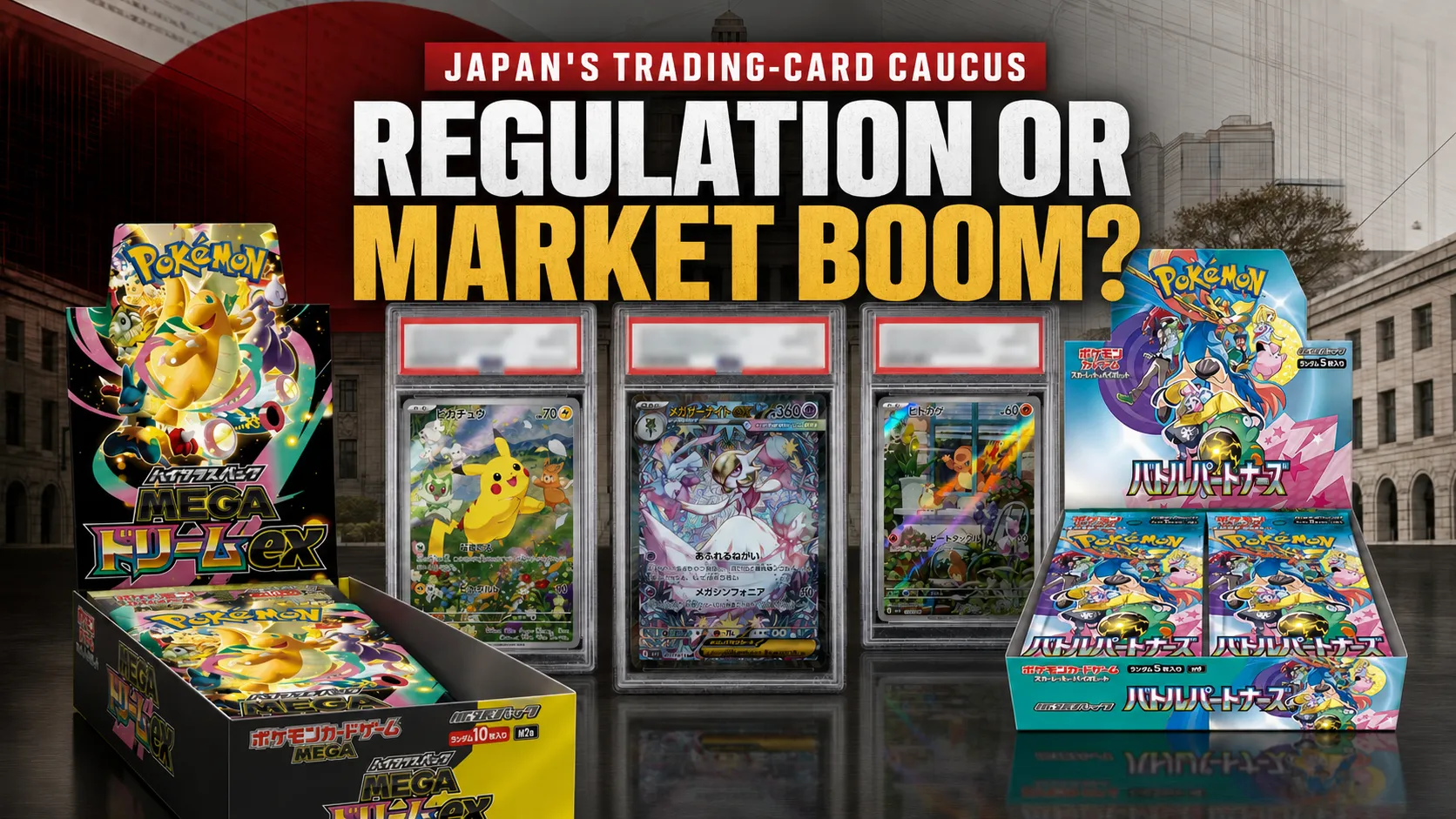
In February 2026, a single Pokémon card — a PSA 10 Pikachu Illustrator — sold for US$16,492,000, a Guinness World Record for any trading card. When individual pieces of cardboard trade like fine art, governments eventually notice. Now they have: members of Japan’s ruling party are moving to create a trading-card “caucus” (a group of lawmakers, known in Japanese as a giren), and overseas collectors are understandably asking what it means for buying Japanese cards.
This is a fast-moving story, and the English-language version of it online is already getting garbled. So we’re going to do one thing carefully: separate what is confirmed from what is speculation. We’re a Japan-based shop that ships Japanese cards to collectors worldwide — this is the news as reported here, read through the lens of what actually affects you as a buyer.
- Confirmed — reported by news outlets or on the record.
- Reality check — a common online claim that is inaccurate.
- Speculation — opinion or rumor circulating online, not established fact.
- Unknown — genuinely undecided, likely settled after the July 23 meeting.
Update · July 23, 2026
The founding meeting has now been held. On July 23, 2026, the caucus was formally launched at the Diet under the official name “Trading Card Promotion Parliamentary League” (トレーディングカード振興議員連盟). Lawmaker Seiji Kihara was named its chairman, saying it is “an industry that can compete on the world stage” and that “cultivating a healthy market is important.” The group heard from an industry body and METI, as planned.
The substance is still the same as before the meeting: no law, no bill text, and no timeline were produced — this remains a caucus, not a regulation. Details confirmed on July 23 are folded into the sections below and flagged with a dated Update note; earlier text that is now outdated is struck through. Speculation is still labelled as speculation.
What actually happened
On July 21, 2026, Japanese wire service Kyodo News reported that volunteer lawmakers from the Liberal Democratic Party (LDP) — Japan’s ruling party — had settled on a plan to launch a parliamentary league (giren) to promote the trading-card industry and set rules around its problems. Regional and national outlets carried the same wire report.
Here is what is on the record:
- Confirmed It is an LDP group. The reporting describes “volunteer LDP lawmakers.” There is no mention of it being cross-party.
- Confirmed A founding meeting
is set forwas held on July 23, 2026. At that meeting the groupplans to hearheard from an industry body and from the Ministry of Economy, Trade and Industry (METI) about the current situation and challenges. - Confirmed The convener is lawmaker Seiji Kihara, a veteran with a finance-ministry background. (His exact title varies between reports — most describe him as a former head of the party’s election strategy committee.) Update (July 23, 2026): at the founding meeting he was named the league’s chairman (kaichō, 会長).
- Confirmed The framing is “promotion + rules,” not a crackdown. The reporting positions trading cards as a content industry to be supported (including exports abroad), with transparency rules attached — not regulation for its own sake.
- Confirmed Three problems are named: (1) counterfeit cards, (2) bulk-buying and scalping, and (3) misuse for money laundering.
Update · July 23, 2026 — the meeting happened
Confirmed at the founding meeting, per the Kyodo News and Yomiuri wire reports carried by Japanese outlets:
- Official name: the “Trading Card Promotion Parliamentary League” (トレーディングカード振興議員連盟). Note the word is promotion — the framing is industry support with rules attached, not a crackdown.
- Chairman: Seiji Kihara. On taking the role he said it is “an industry that can compete on the world stage” and that “cultivating a healthy market is important.” (Original Japanese: 世界で戦える産業だ/健全な市場を育成していくことが重要だ.)
- Who presented: the Japan Trading Card Association (日本トレーディングカード協会, a general incorporated association founded November 2025) and METI briefed the lawmakers on the market’s current state and challenges. The Association said afterward that it raised “responses to counterfeits and sophisticated imitations” among the issues.
- What was NOT produced: no bill, no rule text, no timeline, and no named tax measure. This was a first meeting to gather facts.
What it is NOT — clearing up the English confusion
The English-language version of this story is spreading faster than it is being checked. We’ve seen it described online as a “government task force,” a “new law,” and a “crackdown.” Those framings are misleading, and if you’re a collector, the difference matters.
Reality check It is not a government agency or a “task force.” A giren is a voluntary caucus of lawmakers within a party. It can build momentum and draft proposals, but it does not itself hold regulatory power.
Reality check No law has been passed. There is no bill text, no rule, and no timeline. As of writing, the group has not even held its founding meeting — that is scheduled for July 23, 2026. Update (July 23, 2026): the founding meeting has now been held, but it produced only fact-finding — still no bill, rule, or timeline.
Reality check There is no reported plan to ban or restrict overseas buyers. Nothing in the reporting points to import limits or a ban on foreigners buying Japanese cards. The stated targets are counterfeits, bulk-buying, and money laundering — not international collectors.
If your first reaction was “does this mean I won’t be able to buy Japanese cards anymore?” — the honest answer, based on what has actually been reported, is: there is no indication of that.
Why now: the backdrop you already feel
None of this comes out of nowhere. The pressures behind it are the same ones collectors have been living with for a couple of years.
- Prices and “asset-ification.” The US$16.49 million Pikachu Illustrator is the extreme, but the whole market has re-rated. Japan’s domestic trading-card market reached roughly ¥302.4 billion in FY2024 (official industry figure) and the establishment reporting cites roughly ¥338.4 billion for FY2025 — on the order of US$2 billion.
- Counterfeits. Convincing fakes of high-value cards circulate through flea-market apps and social sales. Authentication currently leans on private graders like PSA (see our guide to how PSA grading works for Japanese cards); there is no legal framework for it.
- Bulk-buying and scalping. Release-day buy-outs mean the kids and fans a set is made for can’t get it at retail. Voluntary purchase limits and lottery sales have only partly helped.
- Theft and money laundering. High-value, lightweight, and easily resold, cards have been linked in Japanese reporting to organized-crime cash-out schemes, and card-shop burglaries have made the news.
| Label | Value |
|---|---|
| FY2020 | ¥122.20 |
| FY2021 | ¥177.60 |
| FY2022 | ¥234.90 |
| FY2023 | ¥277.40 |
| FY2024 | ¥302.40 |
There is also one concrete, already-live change worth knowing about, because it touches how official Japanese cards are bought:
- Confirmed In May 2026, The Pokémon Company announced My Number Card (Japanese national ID) verification for official sales, lotteries, and events, with rollout reported around August 2026 (the ID number itself is not collected). This is a company anti-scalping measure — separate from the LDP caucus — but it is part of the same tightening backdrop.
What it means for you — fact vs. speculation, side by side
Here’s the part that matters if you buy Japanese cards from overseas. We’ve split each question into what is established and what is merely feared or guessed.
| Your question | Where it actually stands | Label |
|---|---|---|
| Will Japanese cards be blocked from export or from overseas buyers? | No such plan has been reported. The stated targets are counterfeits, scalping, and laundering. | Confirmed (not on the table) / a ban is only a fear |
| Will counterfeit protection improve? | Fighting counterfeits is a stated aim — a good direction for buyers. But the concrete mechanism is undecided. | Confirmed aim / mechanism Unknown |
| Will high-value trading or resale get regulated? | Some want tough action on the secondary market; analysts quoted in coverage think a sweeping intervention is unlikely soon. | Speculation / prediction |
| Will cards get taxed as assets? | The reporting contains no specific tax proposal. Talk of an “asset tax” is online speculation. | Unknown / Speculation |
| Will ID checks like My Number spread? | Pokémon’s official-sales ID check is already rolling out — but that’s a company policy, not this caucus. | Confirmed (company policy, separate) |
| New law, or just tighter use of existing law? | Undecided. Commentators expect existing statutes (second-hand dealer, fair-labeling, anti-proceeds-of-crime laws) to do the near-term work. | Unknown + Speculation |
The single most useful takeaway: as reported, this is aimed at bad actors, not at collectors. If anything, a serious push against counterfeits is something honest buyers should welcome — it makes authenticity worth more, not less.
What the Japanese card community is speculating
Speculation Everything in this section is opinion and rumor circulating online — widely shared, but not established fact. We include it because the mood tells you something, and because some of these concerns may shape the July 23 meeting. We are deliberately not naming individuals or asserting anyone’s wrongdoing.
- ”Is the right body being consulted?” The industry group reported to be presenting on July 23 is a newer association led by graders and card shops rather than the big manufacturers (the makers of Pokémon, Yu-Gi-Oh!, and other games are not, by these accounts, members). A lot of online commentary questions whether it can speak for the industry — and whether shops that sell “oripa” (random repack) products steering the conversation is a conflict of interest.
- ”Is this self-regulation to get ahead of real regulation?” A common read is that the timing lets certain sellers set soft rules before stricter ones can be imposed.
- ”Follow the incentives.” Others frame the whole effort as a vehicle for vested interests, or worry aloud about a future “asset tax” on cards.
- ”Don’t punish players and collectors.” There’s real fear that blunt rules could hit pack odds, oripa, purchase limits, or private resale — burdening ordinary hobbyists rather than the bad actors.
- ”Bring in the makers.” Many argue the actual publishers should be at the table, not just resellers.
Update · July 23, 2026 — how the mood moved on meeting day
- What actually happened (fact): between July 22 and 23, the Japan Trading Card Association removed the list of its participating companies from its website. Reporting (KAI-YOU, Sponichi, others) noted the list, while it was up, showed card shops rather than the game makers.
- Speculation That timing poured fuel on the existing “shop alliance / where are the makers?” criticism and on conflict-of-interest worries. This is community reaction, not proof of anything — the Association says it is working with relevant bodies on counterfeits.
- Speculation Commenters also seized on chairman Kihara’s finance-ministry background to revive “will they tax cards as assets?” fears. As of July 23 no tax proposal has been reported — this remains speculation, not a plan.
- Speculation A recurring, telling point of confusion in the reaction: many people conflate the caucus (the lawmakers) with the Association (the industry group). They are two different entities — the caucus is not run by the Association.
Notably, the English-speaking reaction has skewed the other way — several posts framed it approvingly as Japan finally “cracking down on scalpers and counterfeits.” The truth is somewhere in the middle of a story that hasn’t been written yet.
What to watch next
The founding meeting on July 23, 2026 should start to answer the questions that are genuinely open today:
The group’s official name,Update (July 23): the name is now confirmed — “Trading Card Promotion Parliamentary League.” Still open: Unknown its full slate of officers, and which lawmakers actually join.- Unknown Whether the aim is a new law or tighter enforcement of existing ones — and whether tax treatment is even on the agenda.
- Unknown Which industry voices get heard beyond the single association named so far.
Our honest read: the more meaningful signals will be whether a ministry (METI, the Consumer Affairs Agency, or the police) opens a formal study group, and whether the industry lands on credible self-rules — not the caucus’s launch alone. If counterfeits and money laundering are the priority, those are the kinds of problems existing law can already be pointed at, which tends to move faster than an all-new statute.
A note from a Japan-based shop
We sell Japanese single cards to collectors around the world, so we read this story through one practical question: does it make it safer or harder to buy an authentic Japanese card from Japan? On the evidence so far, a real effort against counterfeits points the right way for buyers — authenticity is the whole game. It’s also why we photograph every individual card we list and grade it honestly: no stock photos, what you see is what you get. Whatever the caucus decides, that part doesn’t change. You can browse our current Japanese cards here.
Buying with grading in mind? Our guide to PSA grading Japanese cards walks through authentication and submission, and our cards-to-watch list shows what’s actually moving right now.
FAQ
Will I still be able to buy Japanese Pokémon cards from Japan?
Based on what has been reported, yes — there is no plan to restrict overseas buyers. The caucus’s stated targets are counterfeits, bulk-buying, and money laundering, not international collectors. Any claim that Japan is “banning” card exports is speculation, not reported fact.
Is this a new Japanese law?
No. It is a proposed caucus of ruling-party lawmakers, not a law or a government agency. As of writing it hadn’t held its founding meeting (scheduled July 23, 2026), and there is no bill text or timeline. Update (July 23, 2026): it held its founding meeting on that date and adopted the name “Trading Card Promotion Parliamentary League” — but there is still no bill text, rule, or timeline.
Will this affect card prices?
Unknown, and we don’t make price predictions. In the near term this is a policy discussion, not a rule. The bigger, concrete price-adjacent change is that fakes and scalping are under more scrutiny — which, if anything, tends to reward verified-authentic cards.
Is the Pokémon “My Number” ID check part of this caucus?
No. That’s a separate anti-scalping measure announced by The Pokémon Company in May 2026 for official sales and lotteries in Japan. It shares the same backdrop but is a company policy, not something this LDP group created.
Is a Japanese card safer to buy because of this?
Not yet — nothing has changed legally. The practical protection for a buyer today is still the same as it was last week: buy from a seller who shows you the exact card, documents its condition, and stands behind authenticity.
Sources & methodology
Updated July 23, 2026: this article was first published July 22, 2026, before the founding meeting; it has since been updated with the meeting’s outcome. Dated Update notes and struck-through text mark what changed. The July 23 additions — the official name (“Trading Card Promotion Parliamentary League” / トレーディングカード振興議員連盟), Seiji Kihara’s appointment as chairman and his quoted remarks, and the fact that the Japan Trading Card Association and METI briefed the lawmakers — come from the July 23, 2026 Kyodo News and Yomiuri Shimbun wire reports as carried by Japanese outlets (Yahoo! News Japan, Chunichi Shimbun, Kochi Shimbun, Daily Sports), cross-checked via public web search on July 23, 2026. The report that the Association removed its participating-company list between July 22 and 23 is per KAI-YOU, Sponichi Annex (Oricon) and related coverage. Community sentiment described in the July 23 updates is from public X (Twitter) posts observed on July 23, 2026; it is included as sentiment, not fact, and no individuals are named.
The pre-meeting reporting and public online reaction were current as of July 22, 2026. Core facts about the caucus come from the July 21, 2026 Kyodo News wire report as carried by Japanese outlets (Yahoo! News Japan, Kanaloco/Kanagawa Shimbun, Livedoor News) and were cross-checked via public web search on July 22, 2026. The Pikachu Illustrator sale (US$16,492,000, February 2026) is per Guinness World Records. Market-size figures are from the Japan Toy Association’s “Card Game / Trading Card” category (FY2024 ¥302.4B official; the ¥338.4B FY2025 figure is as cited in the establishment reporting). The May 2026 Pokémon My Number verification announcement is per Japanese tech reporting (ITmedia). US-dollar approximations use roughly ¥162 per US$1 (≈ the reference rate in late July 2026) and are rounded. Statements attributed to “online” reaction are opinions observed on public X (Twitter) posts on July 22, 2026 — they are included as sentiment, not as fact, and no individuals are named.
About JariseStore
JariseStore is a Japan-based specialist in Japanese Pokémon single cards, shipping to collectors worldwide. Every card we sell is sourced in Japan, individually photographed, and honestly graded — no surprises, what you see is what you get. Questions about a card or shipping? Reach out on Instagram @jarisestore.
This article is for informational purposes only and is not legal, tax, or investment advice. It summarizes news reporting and public commentary available as of July 22, 2026 and updated July 23, 2026, which can change quickly; nothing here should be read as a prediction of policy outcomes or card prices. Pokémon and all card names are trademarks of their respective owners; JariseStore is an independent reseller and is not affiliated with The Pokémon Company or any political body.


.png)